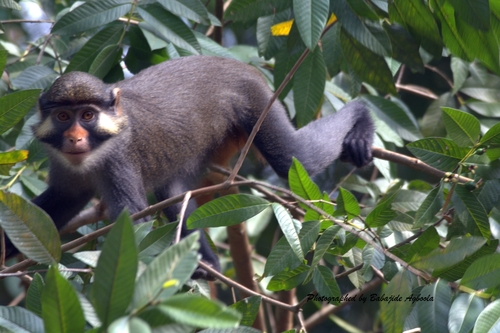
Red-eared Monkey
Cercopithecus erythrotis
Draped in a palette of slate-gray and vivid russet, the Red-eared Monkey is a jewel of the West African canopy. These elusive primates are best known for their striking blue faces and the fiery red ears that give them their name.
Quick Identification
Size
Body length of 35-45 cm (14-18 in) with a tail reaching 50-60 cm (20-24 in); weight ranges from 3-4.5 kg (6.6-10 lbs).
Colors
Agouti grayish-brown fur with a white belly; features bright russet-red ears and a red tail tip, with blue skin around the eyes and yellow cheek whiskers.
Key Features
- Distinctive brick-red or russet fur on the ears and the distal half of the tail
- Vivid light blue skin surrounding the eyes and muzzle
- Bright yellowish or white cheek patches
- Small, slender build with an exceptionally long tail for balance
When You’ll See Them
Behavior
The Red-eared Monkey is a highly social and active primate, typically found in small family groups consisting of a single dominant male and several females with their offspring. They are masters of the mid-to-upper canopy, rarely descending to the forest floor. These monkeys are known for their 'quiet' nature compared to other guenons, often communicating through subtle chirps and facial expressions rather than loud vocalizations, which helps them evade predators in their dense forest habitats.
Interactions with humans are generally limited due to their shy nature and preference for deep forest interiors. However, they are vital to their ecosystem as seed dispersers. Their daily routine involves a morning period of intense foraging followed by a midday rest, usually spent grooming one another to reinforce social bonds. They are often seen in 'polyspecific' associations, hanging out near other monkey species to increase the number of eyes watching for eagles and leopards.
EverydayEarth exclusive
Camera Tips
Capturing the Red-eared Monkey requires a strategy that moves away from the ground and into the trees. Because these monkeys are strictly arboreal, mounting your camera at a height of 10 to 15 feet (3-5 meters) is essential. Look for 'highways'—horizontal branches that connect large fruit trees—as these are the paths they use daily. Use heavy-duty straps to secure the camera and ensure it is angled slightly downward to capture the movement across the branch rather than just the sky.
Since these primates move quickly through the canopy, camera settings are critical. Set your trigger speed to the fastest possible setting (ideally 0.2 seconds or less) to avoid capturing only a trailing tail. High-definition video mode (20-30 seconds) is far superior to still photos for this species, as it allows you to observe their social interactions and unique grooming behaviors which are often missed in a single frame.
Baiting is generally not recommended for wild primates, but placing your camera near a naturally fruiting tree, such as a wild fig (Ficus) or Uapaca, acts as a natural magnet. These trees provide the best opportunity for clear, stationary shots while the monkeys are busy feeding. Ensure your camera's PIR (Passive Infrared) sensitivity is set to high, as their small body mass and the distance from the lens can sometimes make them harder to detect than larger ground mammals.
Lastly, be mindful of the lighting. The dense forest canopy often creates high-contrast environments with bright spots and deep shadows. If your camera has an 'HDR' or 'Auto-ISO' feature, enable it to help balance the exposure. During the rainy season, ensure your housing is perfectly sealed, as the humidity in the Red-eared Monkey's native range can easily fog lenses and damage electronics.
Similar Species
Species that look similar or are commonly confused with Red-eared Monkey.
Red-tailed Monkey
Features a prominent white, heart-shaped spot on the nose and lacks the distinct blue facial skin of the red-eared variety.
Moustached Monkey
Has a distinctive white 'mustache' mark above the upper lip and lacks the bright red ears.
Putty-nosed Monkey
Larger in size with a very obvious white 'putty' spot on the nose and a much darker overall coat.
Frequently Asked Questions
Record Red-eared Monkey at your habitat
Connect a camera to start building your own species record — AI identifies every visitor automatically.