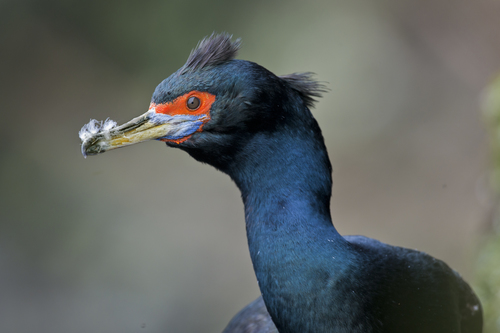
Red-faced Cormorant
Urile urile
A striking inhabitant of the North Pacific's most rugged shores, the Red-faced Cormorant is easily identified by its brilliant scarlet mask and shimmering violet-black feathers. This master of the surf thrives on the steep cliffs and cold currents of the subarctic wilderness.
Quick Identification
Size
Length: 71–84 cm (28–33 in); Wingspan: 110–122 cm (43–48 in); Weight: 1.5–2.5 kg (3.3–5.5 lb)
Colors
Shimmering greenish-black plumage with a deep violet sheen; bright red or orange bare facial skin; bluish-grey bill; white flank patches during the breeding season.
Key Features
- Vibrant red or orange facial skin extending around and behind the eyes
- Prominent double crest on forehead and crown during breeding
- Thin, pale blue-grey bill with a dark tip
- Strictly marine bird with iridescent violet-green feathers
When You’ll See Them
Geographic range
Where Does the Red-faced Cormorant Live?
Native to the wild and windy coastlines of the North Pacific, the Red-faced Cormorant is most concentrated in the Aleutian Islands and the Alaska Peninsula of the United States. Its territory extends westward across the Bering Sea to the Commander and Kuril Islands of Russia, reaching as far south as the northern coasts of Japan. This species is a true wilderness inhabitant, favoring remote, nutrient-rich marine environments over populated coastal areas.
Basemap © OpenStreetMap contributors
Behavior
The Red-faced Cormorant is a dedicated marine specialist, rarely found far from the crashing waves and rocky shorelines of the North Pacific. Unlike many of its cousins, it is a relatively sedentary bird, often remaining near its breeding grounds year-round. They are expert divers, using their powerful webbed feet to propel themselves to the seafloor in search of bottom-dwelling prey. While underwater, they are agile and swift, but on land, they appear somewhat clumsy, perched upright on jagged rocks.
Socially, these cormorants are less colonial than other species, often nesting in smaller, more isolated groups on steep, inaccessible sea cliffs. They spend a significant portion of their day 'wing-drying'—standing with their wings outstretched to shed water, a necessary ritual as their feathers are not fully waterproof to allow for deeper diving. Although they are generally wary of humans, they are fascinating to observe from a distance, especially during their complex courtship displays involving rhythmic neck-twisting and vocalizations.
EverydayEarth exclusive
Camera Tips
Capturing the Red-faced Cormorant on camera requires a specialized setup, as they are strictly coastal birds that do not visit inland suburban backyards. If you have property overlooking rocky cliffs in the North Pacific, position your camera on a high vantage point facing a preferred 'loafing' rock—usually identifiable by white guano stains. These birds love to perch on flat ledges just above the high-tide line to dry their wings, so aiming your camera at these spots during the mid-morning sun is ideal.
Salt spray is your biggest challenge. Use a high-quality weather-sealed housing and consider a lens hood to protect the glass from ocean mist. If possible, mount the camera at a slightly downward angle to capture the iridescent sheen of their feathers against the dark rocks. Use a fast trigger speed (0.2s or less) to catch the moment they land or take off, as their movements can be surprisingly quick despite their bulky appearance.
Since they are active during the day, focus on natural light settings. Early morning or late afternoon light will best highlight the vibrant red skin of their face and the violet tones in their plumage. Avoid using flash, which can be startling and may cause the birds to abandon a preferred perch; instead, rely on the high ISO capabilities of modern AI cameras to handle the overcast, misty conditions common in their subarctic range.
Similar Species
Species that look similar or are commonly confused with Red-faced Cormorant.
Frequently Asked Questions
Record Red-faced Cormorant at your habitat
Connect a camera to start building your own species record — AI identifies every visitor automatically.