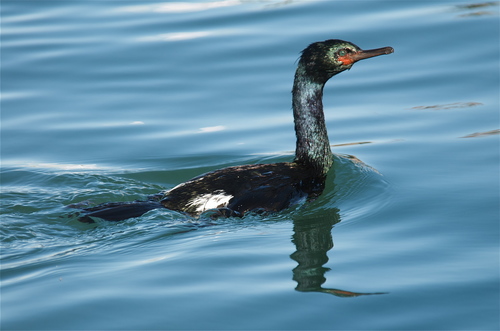
Pelagic Cormorant
Urile pelagicus
With its shimmering emerald feathers and striking white patches, the Pelagic Cormorant is the most elegant diver of the Pacific coast. This small but hardy seabird thrives where the land meets the crashing waves, nesting on the narrowest cliff ledges.
Quick Identification
Size
Length 25-30 in (64-76 cm), Wingspan 39-48 in (100-121 cm), Weight 3.3-5.3 lbs (1.5-2.4 kg)
Colors
Adults are glossy black with a brilliant metallic green and violet iridescence; breeding adults feature prominent white patches on the flanks and a red throat patch.
Key Features
- Slender neck and thin, dark bill
- Smallest North American cormorant
- Metallic green and purple sheen on feathers
- Two small crests on head during breeding season
- White flank patches visible during flight and nesting
When You’ll See Them
Geographic range
Where Does the Pelagic Cormorant Live?
The Pelagic Cormorant is a staple of the Northern Pacific rim, claiming the rugged coastlines of both North America and Asia as its home. Its range stretches from the subarctic waters of Alaska and the Aleutian Islands down through the Pacific Northwest to the shores of Baja California. Across the ocean, they are widely distributed from the Russian Far East and the Kamchatka Peninsula to the coastal regions of Japan and the Korean Peninsula. While some northern populations move south for the winter, many remain year-round residents of their coastal territories.
Basemap © OpenStreetMap contributors
Behavior
The Pelagic Cormorant is the most solitary of the cormorant species, often seen nesting on inaccessible cliff ledges rather than in large, flat colonies. They are master divers, using their relatively small wings to 'fly' underwater in pursuit of prey. Unlike many other seabirds, they possess less waterproof plumage, which necessitates their iconic 'spread-wing' pose as they perch on rocks or docks to dry off after a hunt.
While they are generally shy and avoid human interaction, they are common sights in coastal harbors and near rocky outcroppings. They are known for their extremely high flight costs due to their heavy bodies and short wings, leading them to stay close to the water's surface when traveling. In the winter, they move from their cliff-side homes to more protected coastal waters or the open ocean, though they rarely venture far from land.
EverydayEarth exclusive
Camera Tips
Capturing the Pelagic Cormorant requires a strategic approach since they rarely visit traditional inland backyards. If you live on the coast or have access to a pier, mount your AI-powered camera on a sturdy railing or piling facing rocky outcroppings or frequent 'drying spots.' These birds return to the same perches daily to dry their wings; look for rocks stained white with guano as your primary indicator for camera placement. Position the camera at a slightly upward angle to capture the birds against the sky or ocean backdrop, ensuring you have a clear line of sight to their favorite landing spots.
Because the Pelagic Cormorant has a dark, iridescent plumage, lighting is your biggest challenge. For the best results, set your camera to trigger during the golden hours of early morning or late afternoon. The low-angle sunlight will catch the metallic green and purple highlights that otherwise look flat and black in midday sun. If your camera allows for exposure adjustments, slightly underexposing can prevent the white flank patches of breeding adults from 'blowing out' while preserving the detail in their dark feathers.
Avoid using food lures, as these birds are strictly divers and won't respond to birdseed. Instead, focus on their natural habits. If you are monitoring a nesting site on a cliffside, ensure your camera is securely tethered to prevent it from falling into the sea. High-speed shutter settings or 'burst' modes are essential for this species; they are surprisingly fast when taking off from the water, and their rapid wingbeats are difficult to freeze in motion without a fast trigger and short exposure time.
Similar Species
Species that look similar or are commonly confused with Pelagic Cormorant.
Brandt's Cormorant
Larger than the Pelagic, with a shorter tail and a buff-colored 'mustache' or throat patch in breeding plumage.
Double-crested Cormorant
Much larger with a thick, orange-yellow throat patch and a heavier, hooked bill.
Red-faced Cormorant
Found mostly in Alaska; features more extensive red skin around the eyes and a yellow bill base.
Frequently Asked Questions
Record Pelagic Cormorant at your habitat
Connect a camera to start building your own species record — AI identifies every visitor automatically.