Brandt's Cormorant
Urile penicillatus
A coastal icon of the Pacific, the Brandt's Cormorant is famous for its iridescent black plumage and the stunning cobalt-blue throat it displays during the nesting season. Whether diving through kelp forests or drying their wings on sun-drenched rocks, these social seabirds are a masterclass in maritime survival.
Quick Identification
Size
Length: 70-84 cm (28-33 in); Wingspan: 110-124 cm (43-49 in); Weight: 1.4-2.8 kg (3.1-6.2 lbs)
Colors
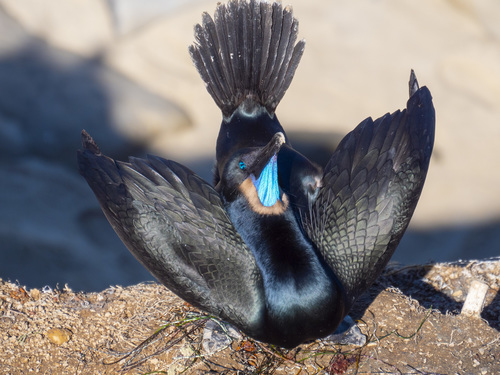
Adults are entirely iridescent black with green and blue sheen; they feature a buff-colored tan patch at the base of the bill and striking cobalt-blue throat skin during the breeding season.
Key Features
- Heavy, hooked bill with a buffy tan 'mustache' patch at the base
- Brilliant blue gular (throat) pouch visible during breeding
- Striking turquoise-green eyes
- Thick-necked profile compared to other cormorants
When You’ll See Them
Sightings on EverydayEarth
Apr 10, 2026
Several Brandt's Cormorants are seen diving and swimming rapidly through the underwater kelp forest, likely hunting for small fish. Their large webbed feet and streamlined bodies allow for efficient movement as they maneuver through the water. A few small fish, including a bright orange Garibaldi, drift in the background near the seafloor.
Geographic range
Where Does the Brandt's Cormorant Live?
The Brandt's Cormorant is a signature species of the North American Pacific Coast, ranging from the Gulf of Alaska down to the southern tip of Baja California and into the Gulf of California. While they are essentially a West Coast exclusive, their highest population densities are found along the rugged shores of California, Oregon, and Washington. Most populations remain year-round residents, though birds at the northernmost edge of the range typically move south toward British Columbia and the United States during the harsher winter months.
Basemap © OpenStreetMap contributors
Behavior
During the spring, males engage in elaborate courtship displays to claim nesting sites on steep cliffs. They draw attention by flapping their wings to show off white filament-like plumes on their necks and puffing out their vibrant blue throat pouches. While they are generally cautious around people, they are a frequent sight in coastal harbors and marinas, where they have learned to coexist with human activity as long as their nesting sites remain undisturbed.
EverydayEarth exclusive
Camera Tips
Lighting is your best friend when trying to capture their dark, iridescent plumage. Position the camera with the sun at its back to illuminate the subtle greens and blues of their feathers. The 'golden hour'—just after sunrise or before sunset—is the ideal time to catch the brilliant cobalt-blue of their throat pouch and their striking turquoise eyes without the harsh glare of midday sun reflecting off the water. If your camera has adjustable frame rates, choose 60fps or higher to capture the sharp details of them shaking water off their wings or landing in the surf.
Since these birds are pursuit divers and do not eat land-based food, traditional baiting will not work. Instead, focus on 'passive' attraction by ensuring the camera has a clear line of sight to a preferred perching spot. Because coastal environments are harsh, use a camera with a high IP weather-resistance rating. Salt spray can quickly cloud a lens, so check and clean the housing with a soft, damp cloth weekly. If you are setting up near a known nesting colony, maintain a significant distance and use a telephoto or zoom-capable camera to avoid disturbing the birds, as they are sensitive to close human presence during the egg-laying phase.
Similar Species
Species that look similar or are commonly confused with Brandt's Cormorant.
Double-crested Cormorant
Has a bright orange-yellow throat patch and is commonly found in freshwater lakes and rivers, unlike the strictly marine Brandt's.
Pelagic Cormorant
Much smaller and thinner-necked with a reddish throat patch during breeding and a more metallic purple-green gloss.
Great Cormorant
Found primarily on the Atlantic coast; it is larger with a white patch on the thigh and a yellow-and-white throat area.
Frequently Asked Questions
Record Brandt's Cormorant at your habitat
Connect a camera to start building your own species record — AI identifies every visitor automatically.