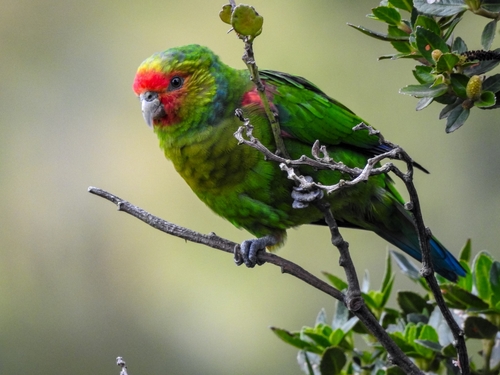
Red-faced Parrot
Hapalopsittaca pyrrhops
A vibrant flash of crimson in the misty Andean heights, the Red-faced Parrot is one of the world's most elusive high-altitude birds. Finding one is a rare privilege for any wildlife enthusiast.
Quick Identification
Size
22–23 cm (8.5–9 inches) in length; approximately 100–120g (3.5–4.2 oz)
Colors
Primary green body with a brilliant red face, forehead, and lores. Dull yellow-green underparts and blue-edged flight feathers.
Key Features
- Bright crimson mask across the forehead and eyes
- Pale ivory-colored bill
- Compact, short-tailed silhouette
- Indigo-blue primary wing feathers
When You’ll See Them
Geographic range
Where Does the Red-faced Parrot Live?
This rare avian treasure is native to the high Andes of South America. Its highly restricted range is concentrated in southern Ecuador, specifically within the provinces of Azuay and Loja, and extends just across the border into the department of Piura in northern Peru. Because it relies on specialized temperate forest ecosystems, its distribution is naturally fragmented and limited to narrow elevation bands.
Basemap © OpenStreetMap contributors
Behavior
The Red-faced Parrot is a social but relatively quiet species compared to its louder lowland cousins. They are typically found in small family groups or flocks of up to 10 individuals, moving through the canopy of high-altitude forests. While they are active throughout the day, they spend much of their time feeding silently among the branches, making them difficult to spot without the aid of a camera or binoculars.
These parrots are known for their altitudinal movements, shifting their range slightly depending on the seasonal availability of specific fruits and flowers. In flight, they emit soft, metallic calls to keep the flock together as they navigate across misty mountain valleys. They are sensitive to human disturbance and remain strictly tied to undisturbed primary forest fragments.
EverydayEarth exclusive
Camera Tips
Capturing high-quality footage of the Red-faced Parrot requires placing your equipment in the high-elevation cloud forest canopy. To find success, identify flowering Gynoxys trees or fruiting shrubs, as these act as natural magnets for the species. Mounting your camera on a ridge-top tree where the canopy is more accessible can provide a better line of sight than looking up from the dark forest floor.
Lighting is your biggest challenge in the misty Andes. Use a camera with a high-quality sensor capable of handling low-light conditions and dappled shadows. If your AI camera supports it, set a fast trigger speed to catch these birds as they flit quickly between branches. Because the environment is exceptionally humid and cool, ensure your camera housing is rated for high moisture and consider using anti-fog inserts inside the lens port.
External power is vital for remote Andean setups. The combination of cold mountain air and high-resolution recording will drain standard batteries fast; a solar panel mounted in a nearby clearing with a long cable to the camera is the gold standard. To increase your chances of a close-up, look for natural 'mineral licks' or small water catchments in the crooks of large trees where the parrots may descend to drink or bathe.
Similar Species
Species that look similar or are commonly confused with Red-faced Parrot.
Frequently Asked Questions
Record Red-faced Parrot at your habitat
Connect a camera to start building your own species record — AI identifies every visitor automatically.