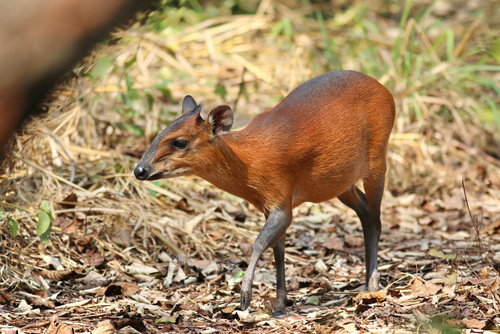
Red-flanked Duiker
Cephalophorus rufilatus
A vibrant burst of orange in the forest understory, the Red-flanked Duiker is a master of the 'hide and seek' game. With its striking blue 'racing stripe' and dainty features, this small African antelope is a favorite for daytime trail camera enthusiasts.
Quick Identification
Size
Shoulder height: 30-38 cm (12-15 in); Length: 60-70 cm (24-28 in); Weight: 6-14 kg (13-31 lbs)
Colors
Vibrant reddish-orange or rufous body with a distinct bluish-gray stripe running along the spine; dark gray or black lower legs.
Key Features
- Prominent blue-gray dorsal stripe from neck to tail
- Dark blackish-gray 'socks' on the lower legs
- Short, straight horns present on males and occasionally females
- Arched back and low-slung head profile
When You’ll See Them
Behavior
Red-flanked Duikers are highly alert and somewhat secretive mammals, though they are more diurnal than many other duiker species. They spend much of their day moving through dense undergrowth, using a cautious, high-stepping gait. When startled, they live up to their name—'duiker' means 'diver' in Afrikaans—by plunging headlong into the nearest thicket to disappear from sight.
These small antelopes are primarily solitary, though they are often found in pairs during the breeding season. They are highly territorial and possess large preorbital glands (visible as slits below the eyes) which they rub against branches and stems to mark their home range. Unlike some more nomadic species, a Red-flanked Duiker will often stay within the same small territory for years, making them reliable subjects for long-term camera monitoring.
EverydayEarth exclusive
Camera Tips
To capture high-quality footage of the Red-flanked Duiker, camera height is the most critical factor. Because these animals stand only about a foot tall at the shoulder, your camera should be mounted very low—ideally 12 to 18 inches off the ground. If the camera is mounted at human waist height, you will likely only capture the top of their backs or miss them entirely due to the narrow detection zone of many PIR sensors at close range.
Focus your efforts on 'edge' habitats where thick cover meets more open foraging areas. Look for 'game trails' that look like small tunnels through the brush; these are the duiker’s primary highways. Placing a camera near a known water source or beneath a fruiting tree (such as a wild fig) is the most effective way to guarantee a sighting. Because they are diurnal, you don't need to worry as much about high-end infrared flash, but a fast trigger speed is essential as they tend to move quickly through open patches.
If you are using a camera with video capabilities, set it to record 15-20 second clips. This often allows you to see the animal's fascinating scent-marking behavior, where they press the side of their face against a twig. Avoid using heavy scents or lures that aren't fruit-based, as these shy creatures are easily spooked by foreign smells. Instead, clearing a small 3-foot 'stage' in front of the camera of crunchy leaves can help ensure the animal pauses long enough for the sensor to trigger.
Lastly, consider the sun's position. Since they are most active in the early morning and late afternoon, try to face your camera North or South to avoid the heavy backlighting or lens flare that occurs when the sun is low on the horizon. This will ensure the vibrant reddish-orange of their coat and the signature blue dorsal stripe are clearly visible in your shots.
Similar Species
Species that look similar or are commonly confused with Red-flanked Duiker.
Blue Duiker
Much smaller with a uniform grayish-blue coat and lacking the bright orange flanks and dorsal stripe.
Maxwell's Duiker
Generally grayish-brown in color without the distinct reddish-orange body and blue spinal stripe of the Red-flanked.
Bay Duiker
Larger and heavier with a much wider, darker dorsal stripe that extends more broadly across the back.
Frequently Asked Questions
Record Red-flanked Duiker at your habitat
Connect a camera to start building your own species record — AI identifies every visitor automatically.