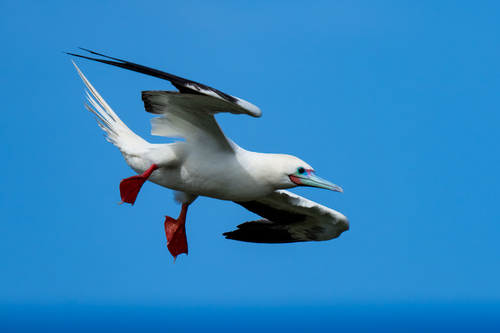
Red-footed Booby
Sula sula
Meet the most acrobatic member of the booby family, famous for its striking scarlet feet and impressive aerial displays. The Red-footed Booby is a tropical icon that brings a splash of color to the coastal canopy.
Quick Identification
Size
Length: 26-30 inches (66-77 cm); Wingspan: 36-40 inches (91-101 cm); Weight: 1.8-2.3 lbs (0.8-1 kg)
Colors
Adults have bright red feet; plumage can be white, brown, or a mix of both. They typically feature a pale blue bill with a pinkish base.
Key Features
- Vibrant red or scarlet feet
- Pale blue bill with pinkish skin at the base
- Smallest of all booby species
- Nests in trees and shrubs rather than on the ground
- Large, dark eyes specialized for foraging
When You’ll See Them
Behavior
Red-footed Boobies are the acrobats of the tropical seas. They are exceptionally agile in flight, capable of catching flying fish mid-air or performing shallow, high-speed dives into the waves. Unlike most other boobies, they have a unique ability to perch on branches, thanks to their strong, red feet that can grip limbs. This allows them to nest in the coastal canopy of mangroves and shrubs, keeping their eggs safe from ground predators.
On land, they are significantly less graceful, often appearing clumsy during takeoffs and landings as they navigate the branches of their nesting colonies. They are highly social birds that live in large colonies, communicating through a series of harsh squawks and guttural calls. While they are generally wary of humans, they are focused parents, with both the male and female sharing the duties of incubating their single egg and feeding the chick.
EverydayEarth exclusive
Camera Tips
To capture high-quality footage of a Red-footed Booby, you must account for their preference for heights. Unlike ground-dwelling seabirds, these boobies spend their time in the canopy of coastal trees. Position your camera on a sturdy branch or a high-mounted pole roughly 6 to 10 feet off the ground. Aiming the camera toward a clear 'landing branch'—a limb that sticks out from the main foliage—will give you the best chance of capturing clear, stationary shots of the birds as they return from the sea.
In terms of camera settings, speed is your best friend. If your AI camera allows for adjustable shutter speeds, aim for 1/1000th of a second or faster to avoid motion blur during their rapid landings. Because the white plumage of many Red-footed Boobies can reflect intense tropical sunlight, setting your exposure to -0.5 or -0.7 will help prevent the highlights from washing out, ensuring you can still see the fine texture of their feathers and the subtle blue of their bills.
Timing is also key for wildlife cameras. While they are diurnal, Red-footed Boobies are known to return to their colonies in large numbers during the 'golden hour' just before sunset. This provides the most dramatic lighting for their scarlet feet. If you are using a trail camera with infrared (IR) capabilities, you may even catch them departing for nocturnal foraging trips on nights with a full moon, a behavior unique among many of their relatives.
Lastly, keep in mind that these birds are attracted to areas with minimal human disturbance. If you are setting up a camera near a known colony, do so quickly and during the middle of the day when many birds are out at sea. Avoid using any bright artificial lights or flash, as this can disorient the birds; instead, rely on the high ISO capabilities of modern sensors to capture the action in the dim light of the mangroves.
Similar Species
Species that look similar or are commonly confused with Red-footed Booby.
Brown Booby
Duller yellow-green feet and a dark brown head and back; always nests on the ground.
Blue-footed Booby
Larger body with bright turquoise-blue feet and a different, ground-based nesting habit.
Masked Booby
The largest booby, featuring a distinct black mask around the eyes and yellow bill, with no red on the feet.
Frequently Asked Questions
Record Red-footed Booby at your habitat
Connect a camera to start building your own species record — AI identifies every visitor automatically.