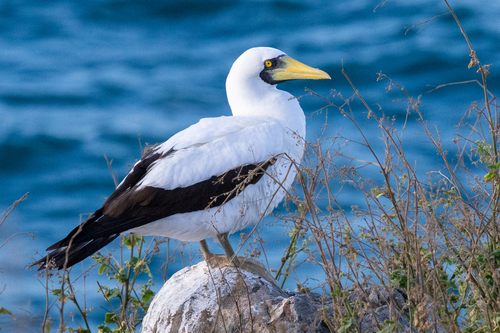
Masked Booby
Sula dactylatra
Meet the largest of the booby family, a striking white-and-black seabird known for its dramatic plunge-dives and iconic dark facial mask. Whether soaring over tropical reefs or nesting on remote atolls, the Masked Booby is a true icon of the open ocean.
Quick Identification
Size
Length 75–85 cm (30–33 in); wingspan 152–170 cm (60–67 in); weight 1.2–2.3 kg (2.6–5.1 lb)
Colors
Bright white body with jet-black wing tips and tail; dark blue-gray facial mask; bill ranges from pale yellow to greenish-yellow
Key Features
- Distinct dark blue-gray facial mask around the bill and eyes
- Largest species in the booby family
- Bright white plumage with contrasting black flight feathers
- Long, stout yellowish bill
When You’ll See Them
Geographic range
Where Does the Masked Booby Live?
This majestic seabird is a true citizen of the world’s tropical oceans, maintaining a vast presence across the Indian and Pacific Oceans, as well as the tropical Atlantic. They are most commonly found nesting on remote oceanic islands and coral atolls within the tropical belt, spanning from the Caribbean and Gulf of Mexico across to the Hawaiian Islands and northern Australia. While they roam widely across the open sea for food, they remain tethered to stable, predator-free islands for their annual breeding cycles.
Basemap © OpenStreetMap contributors
Behavior
The Masked Booby is a master of the air and sea, known for its spectacular high-altitude plunge dives. They often forage far out at sea, sometimes in large mixed-species flocks, using their keen eyesight to spot schools of fish from great heights before tucking their wings and piercing the water like a spear. Because they spend so much time over the open ocean, they are rarely seen near mainland coasts except during heavy storms.
On land, they are social but territorial nesters, colonizing remote oceanic islands and coral atolls. Their social structure is fascinating but harsh; they typically lay two eggs, yet only one chick survives due to 'obligate siblicide,' where the older chick ejects the younger from the nest shortly after hatching. While they generally ignore humans on remote islands, they are highly sensitive to disturbance during the nesting phase and will defend their small territory with sharp bill jabs.
EverydayEarth exclusive
Camera Tips
Capturing the Masked Booby on camera requires a specialized approach since these birds are rarely found in traditional backyards unless you live on a tropical coastline or remote island. The best results come from placing cameras near known nesting colonies on sandy or rocky ground. Since they are ground nesters, position your camera low to the ground—about 12 to 18 inches high—to capture their eye-level interactions and the dramatic black-and-white contrast of their plumage.
Focus your setup on flat, open areas with little vegetation where they prefer to scrape out their nests. Because the tropical sun can be harsh and cause 'blown-out' highlights on their bright white feathers, try to angle your camera to avoid direct midday sun or use a camera with a high dynamic range (HDR) setting. Early morning and late afternoon provide the best natural light for showing the texture of their feathers and the subtle blue-gray of their facial mask.
Masked Boobies are relatively stationary when nesting, so time-lapse mode is an excellent way to capture colony behavior without filling your SD card with repetitive motion triggers. If you are using motion sensors, set the sensitivity to medium; their large size and distinct movement usually trigger cameras easily. Avoid using artificial baits as these birds are strictly ocean hunters, but setting up near a prominent 'landing strip' or high point on a cliff can result in stunning take-off and landing shots.
Similar Species
Species that look similar or are commonly confused with Masked Booby.
Nazca Booby
Found in the eastern Pacific; it has a more orange-toned bill and slightly different nesting preferences.
Blue-footed Booby
Smaller with distinctive bright blue feet and mottled brown plumage on the wings and back.
Northern Gannet
Larger North Atlantic relative that lacks the black facial mask and has a yellowish head during breeding season.
Frequently Asked Questions
Record Masked Booby at your habitat
Connect a camera to start building your own species record — AI identifies every visitor automatically.