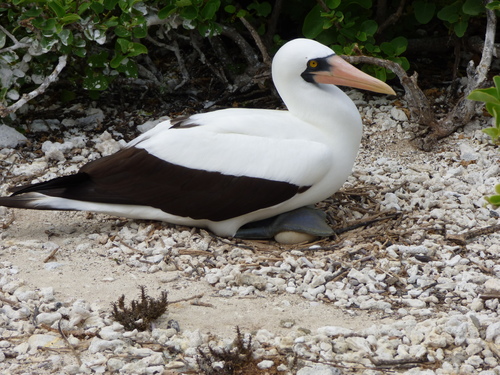
Nazca Booby
Sula granti
Master of the volcanic cliffs and high-speed ocean dives, the Nazca Booby is the masked icon of the Galápagos. With its striking orange bill and fearless personality, it offers a window into the raw, dramatic beauty of Pacific island life.
Quick Identification
Size
Length: 81-92 cm (32-36 in); Wingspan: 150 cm (59 in); Weight: 1.5-2.2 kg (3.3-4.8 lb)
Colors
Brilliant white body plumage with contrasting black flight feathers and a black tail. Features a prominent dark gray-to-black facial mask and a distinctive orange-yellow bill. Males and females are visually identical, though females are often larger with a slightly different vocalization.
Key Features
- Vibrant orange-yellow bill
- Distinctive black 'Zorro' mask around the eyes
- Solid black tail feathers
- Large, aerodynamic white body with black wing edges
When You’ll See Them
Behavior
The Nazca Booby is a social but fierce seabird known for its colonial nesting habits on rocky volcanic islands. They are most famous for 'obligate siblicide,' a reproductive strategy where the older chick pushes its younger sibling out of the nest to ensure its own survival. While this seems harsh, it is a fascinating adaptation to the boom-and-bust food cycles of the eastern Pacific.
In the air, they are spectacular athletes. They hunt by soaring high above the ocean before tucking their wings and plunge-diving at high speeds to catch fish. On land, they are surprisingly approachable and exhibit complex social displays, including sky-pointing and ritualized gift-giving of stones or twigs during courtship.
EverydayEarth exclusive
Camera Tips
Capturing the Nazca Booby requires a focus on ground-level action. Since these birds nest directly on the rocky soil or lava fields, place your camera on a low tripod or a secure rock mount no more than 12-18 inches off the ground. Aim for a wide-angle lens setting to capture the social dynamics of the colony, as their interactions often involve several birds in the frame at once. Because they inhabit coastal environments, salt spray can quickly cloud your lens; if possible, use a protective housing and plan to wipe the lens daily.
Lighting is your biggest challenge and your best friend. The bright white plumage of the Nazca Booby easily 'blows out' in harsh midday sun, resulting in lost detail. Set your camera’s exposure compensation to -1.0 or -2.0 to preserve the texture of their feathers. The best shots occur during the 'golden hours' of sunrise and sunset when their orange bills glow against the dark volcanic backdrop. Use a fast shutter speed or high-frequency trigger to catch the split-second 'sky-pointing' displays where they arch their necks toward the sky.
For those monitoring nesting sites, time-lapse mode is highly effective. Setting a 5-minute interval during daylight hours can document the growth of chicks and the fascinating (if sometimes brutal) sibling interactions without filling up your SD card too quickly. Avoid using any artificial lures or food; these birds are naturally curious and will often walk right up to a static camera if it is left undisturbed. Ensure your camera is tethered or weighted down, as curious juveniles have been known to peck at or tip over gear.
Similar Species
Species that look similar or are commonly confused with Nazca Booby.
Masked Booby
Very similar in appearance but has a pale yellow bill and slightly different genetic lineage.
Blue-footed Booby
Easily distinguished by its bright blue feet and mottled brown-and-white wing plumage.
Red-footed Booby
Smaller with red feet, a blue-tinted bill, and often nests in trees or shrubs rather than on the ground.
Frequently Asked Questions
Record Nazca Booby at your habitat
Connect a camera to start building your own species record — AI identifies every visitor automatically.