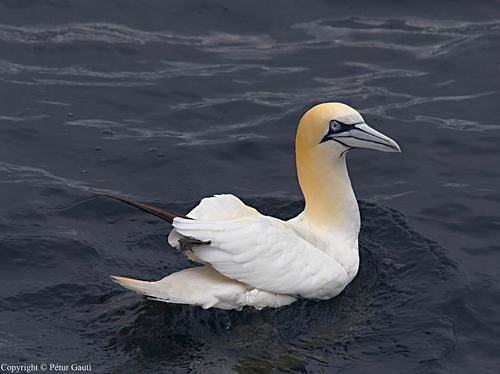
Northern Gannet
Morus bassanus
Witness the spectacular power of the North Atlantic's largest seabird. From their 60-mph plunge dives to their elegant golden-crowned flight, Northern Gannets are a masterpiece of avian engineering.
Quick Identification
Size
Length: 87-100 cm (34-39 in) | Wingspan: 170-180 cm (67-71 in) | Weight: 2.2-3.6 kg (4.9-7.9 lb)
Colors
Adults are snow-white with black wingtips and a golden-yellow wash on the head; juveniles are mottled grey-brown, gradually whitening over five years.
Key Features
- Large, streamlined white body with black-tipped wings
- Long, dagger-shaped blue-grey bill
- Golden-yellow plumage on the head and nape during breeding season
- Distinctive black facial skin forming a mask around the eyes
When You’ll See Them
Behavior
The Northern Gannet is the undisputed heavy-hitter of the North Atlantic skies. These birds are most famous for their breathtaking hunting displays, where they soar to heights of 100 feet before folding their wings and plummeting into the sea at speeds reaching 60 mph. To survive these high-velocity impacts, they possess specialized air sacs beneath the skin of their face and chest that act like a car's airbag, cushioning the blow as they hit the water.
Socially, gannets are highly colonial, gathering in the thousands on sheer coastal cliffs to breed. While they are graceful and silent in flight, their nesting colonies are a cacophony of guttural calls and bill-clattering displays. They are fiercely territorial of their nest sites, but at sea, they can be seen following fishing vessels or joining pods of dolphins to capitalize on schools of fish pushed to the surface.
EverydayEarth exclusive
Camera Tips
Capturing the Northern Gannet on camera is a thrilling challenge, primarily because they are masters of the open ocean. If you are lucky enough to have a coastal overlook or cliffside property, position your camera facing the water or toward known flight paths. Because these birds are brilliantly white, they often 'blow out' in direct sunlight, losing all feather detail. To prevent this, manually adjust your camera's exposure compensation to -1.0 or -2.0; this keeps the whites crisp and reveals the subtle golden hues on their heads.
The action happens fast. If you are using a trigger-based trail camera, set it to the highest possible sensitivity and use 'Burst Mode' or 'Multi-Shot.' A Northern Gannet's plunge dive is over in a fraction of a second, and a single photo rarely captures the drama. If your camera settings allow for it, prioritize a fast shutter speed (at least 1/2000s) to freeze the bird mid-air. For video, 60fps or higher is ideal so you can slow down the footage to appreciate the mechanics of their dive.
Since you cannot use traditional bait to attract a gannet, you must rely on their natural patterns. They are most active when the tide is turning and baitfish are moving. During the breeding season, look for 'flight lines'—consistent paths the birds take from the colony to the fishing grounds. Mounting your camera 4-6 feet high on a sturdy post or tripod will give you the best angle on the horizon. Finally, remember that salt spray is the enemy of electronics; always use a weather-sealed housing and wipe the lens with a microfiber cloth daily to ensure your shots remain crystal clear.
Similar Species
Species that look similar or are commonly confused with Northern Gannet.
Northern Fulmar
Much smaller with a 'tubeneose' bill and stiffer wingbeats; lacks the gannet's black wingtips and golden head.
Great Black-backed Gull
Has a dark mantle (back) and wings, whereas the gannet is almost entirely white with only black wingtips.
Masked Booby
Found in tropical waters rather than the North Atlantic; has a much more extensive black mask and a different tail shape.
Frequently Asked Questions
Record Northern Gannet at your habitat
Connect a camera to start building your own species record — AI identifies every visitor automatically.