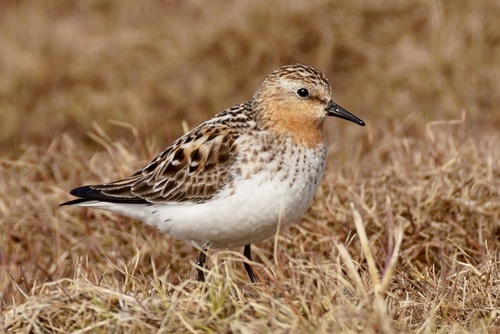
Red-necked Stint
Calidris ruficollis
A tiny traveler with a massive heart, the Red-necked Stint journeys thousands of miles from the Siberian tundra to southern shores. Despite its small size, this energetic wader is a marvel of endurance and a highlight for any coastal camera setup.
Quick Identification
Size
Length: 13–17 cm (5.1–6.7 in); Wingspan: 28–37 cm (11–14.5 in); Weight: 20–50 g (0.7–1.8 oz)
Colors
In breeding plumage, adults show a rich brick-red wash over the face, throat, and upper breast. In the non-breeding season, they are plain grey-brown above and stark white below. Sexes are similar, though females may be slightly larger.
Key Features
- Distinctive brick-red face and neck during breeding season
- Short, straight black bill with a slightly bulbous tip
- Fine, dark streaks on the crown and back
- Dark legs and unwebbed toes
- Diminutive size, often the smallest wader in a flock
When You’ll See Them
Behavior
The Red-necked Stint is a social dynamo of the shorebird world. They are almost always found in flocks, ranging from a dozen individuals to several thousand. On the ground, they move with a frantic, 'clockwork toy' energy, pecking rapidly at the mud or sand as they search for food. They are highly migratory, performing an incredible journey twice a year along the East Asian-Australasian Flyway, traveling from the Siberian tundra to the Southern Hemisphere.
When disturbed, the entire flock will take flight simultaneously, performing synchronized aerial maneuvers that flash their white undersides against the sky. While they are generally wary of predators, they can be quite approachable by humans if you remain still, often foraging just a few meters away from a quiet observer.
EverydayEarth exclusive
Camera Tips
To capture high-quality footage of Red-necked Stints, your primary challenge is their small size and the reflective nature of their coastal habitat. We recommend placing your camera as low to the ground as possible—ideally just a few inches above the sand or mud. This 'frog’s eye' perspective creates a more intimate, professional-looking shot and helps to isolate the bird against the background blur. If you are using a trail camera, a small 'gorilla' tripod or a low-profile ground stake is essential.
The secret to stint photography is tidal timing. Research the local tide charts and set up your camera about two hours before high tide. As the water rises, it covers the distant mudflats and forces the foraging stints closer to the shoreline where your camera is positioned. Look for 'hotspots' like shallow puddles left behind by the receding tide or areas with high concentrations of washed-up seagrass, as these act as natural larders that attract large numbers of birds.
Because these birds move incredibly fast, use the highest shutter speed or frame rate your camera allows. If your AI-powered camera has a 'high sensitivity' or 'fast motion' mode, enable it to prevent the birds from appearing as grey blurs. For video, 60fps or higher is ideal. Position your camera with the sun behind it to illuminate the subtle textures of their plumage and to highlight the red wash on their necks if they are in breeding plumage.
Lastly, consider the environment. Saltwater and sand are the enemies of electronics. Ensure your camera is in a waterproof housing and, if possible, place it slightly back from the direct splash zone. You don't need bait; instead, use 'natural lures' by placing the camera near a small depression in the sand that holds water, as stints will often stop there to wash the salt from their feathers or drink.
Similar Species
Species that look similar or are commonly confused with Red-necked Stint.
Little Stint
Nearly identical but has longer legs and a finer bill; lacks the deep red throat during breeding.
Sanderling
Larger and much whiter in non-breeding plumage, often seen 'racing' the waves on sandy beaches.
Sharp-tailed Sandpiper
Significantly larger with a distinctive chestnut cap and more heavily streaked breast.
Frequently Asked Questions
Record Red-necked Stint at your habitat
Connect a camera to start building your own species record — AI identifies every visitor automatically.