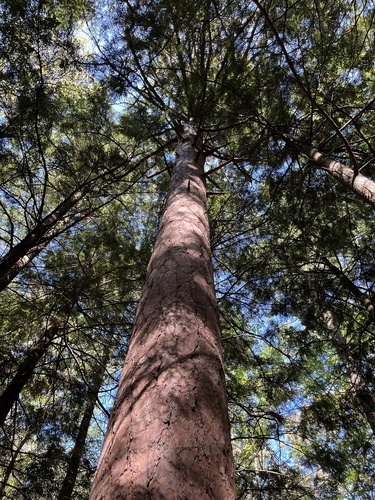
red pine
Pinus resinosa
A titan of the North Woods, the red pine is easily recognized by its tall, straight trunk and distinctive puzzle-piece bark. It provides a year-round sanctuary for backyard birds and a bountiful harvest for energetic squirrels.
Quick Identification
Size
Height 20-35 meters (65-115 feet); Trunk diameter up to 1 meter (3 feet)
Colors
Reddish-brown to pinkish bark plates; dark green needles; light brown cones
Key Features
- Needles in bundles of two, 4-6 inches long
- Brittle needles that snap cleanly when bent
- Flaky, reddish-orange bark that forms large flat plates
- Small, egg-shaped cones without prickles
- Straight, tall trunk with a rounded crown
When You’ll See Them
Behavior
The red pine is a resilient, sun-loving conifer that defines the landscapes of the Great Lakes and Northeast. Unlike many other pines, it is remarkably shade-intolerant, meaning it thrives in open areas or where fire has cleared the canopy. It grows relatively quickly in its youth and can live for over 400 years, eventually developing a thick, fire-resistant bark that allows it to survive low-intensity forest fires that would kill competing species.
In a backyard or woodlot setting, the red pine serves as a vital 'anchor' species. It provides year-round thermal cover for wildlife and serves as a primary nesting site for various raptors and songbirds. While it doesn't 'behave' in the animal sense, its presence dictates the local ecosystem, influencing soil acidity through its needle cast and providing a consistent food source through its biennial seed production cycles.
EverydayEarth exclusive
Camera Tips
When using a red pine as a backdrop for your wildlife camera, the bark is your biggest asset. The deep fissures and reddish plates provide incredible texture for daytime shots. Mount your camera about 3-5 feet high on a neighboring tree facing the red pine to capture squirrels, nuthatches, and woodpeckers that frequent the trunk. The rough bark is a favorite hiding spot for insects, which in turn attracts Brown Creepers and Downy Woodpeckers—set your trigger speed to 'Fast' to catch these quick-moving foragers.
Red pines are famous for attracting the American Red Squirrel, which will often use the base of the tree as a 'midden' (a pile of cone scales). If you find a pile of chewed cone debris at the base of your tree, aim your camera downward at a 45-degree angle toward the trunk's base. This is a high-traffic area where you are guaranteed to capture territorial behavior and feeding habits. Use a 'Burst' mode setting of 3-5 photos to ensure you get a clear shot of the squirrel's face between its rapid movements.
For those looking to capture larger mammals, the red pine's straight trunk makes it an excellent mount for the camera itself. Because the trunk is so stable, you won't get the 'false triggers' caused by wind-sway that you might experience with thinner trees. Position the camera facing a game trail or a clearing. Since red pines often grow in groves with little underbrush, you can achieve a very long 'depth of field,' allowing your AI camera to identify deer or foxes from a significant distance.
Seasonally, winter is the best time to monitor your red pine. The dense evergreen needles provide a 'thermal blanket' that attracts deer to bed down underneath during heavy snow. Place your camera on the leeward side of the tree (usually the side facing away from the prevailing wind) and keep the sensitivity on 'High' to detect the heat signature of a resting animal against the cold backdrop. Ensure your camera is angled slightly downward to avoid the glare of the sun reflecting off the snow, which can wash out the beautiful orange hues of the pine's bark.
Similar Species
Species that look similar or are commonly confused with red pine.
Frequently Asked Questions
Record red pine at your habitat
Connect a camera to start building your own species record — AI identifies every visitor automatically.