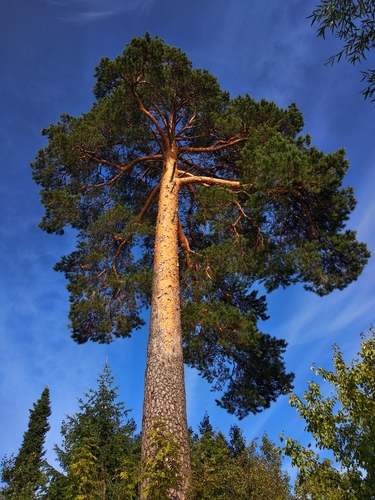
Scots pine
Pinus sylvestris
With its striking orange bark and rugged, wind-swept silhouette, the Scots pine is the king of the northern forest. It is a vital sanctuary for rare wildlife and a beautiful, resilient evergreen addition to any large landscape.
Quick Identification
Size
Height: 25-35m (82-115ft); Trunk diameter: 0.6-1.2m (2-4ft)
Colors
Distinctive orange-red bark on the upper trunk and branches; blue-green needles; grey-brown fissured bark at the base.
Key Features
- Upper bark is a striking flaky orange-red
- Short, twisted blue-green needles found in pairs
- Small, egg-shaped woody cones that point backward
- Rugged, flat-topped canopy in mature specimens
When You’ll See Them
Behavior
The Scots pine is a resilient pioneer species, often the first to colonize open ground in the wild. It grows rapidly during its first few decades, eventually developing a majestic, irregular crown that provides a high-canopy habitat for various specialist species. Unlike many other conifers that remain bushy to the ground, the Scots pine naturally sheds its lower branches as it matures, leaving a long, clean trunk that showcases its beautiful, color-shifting bark.
In the landscape, these trees act as vital ecosystem hubs. They possess a deep taproot system that allows them to thrive in poor, sandy, or rocky soils where other trees might struggle. As an evergreen, the Scots pine offers year-round shelter from the elements and is a cornerstone species for biodiversity, supporting hundreds of insect species which in turn attract birds and small mammals to your yard.
EverydayEarth exclusive
Camera Tips
Capturing the Scots pine on an AI-powered camera is less about catching 'movement' of the tree itself and more about documenting the incredible biodiversity it supports. To see the tree in its best light, mount your camera on a neighboring structure or a high-quality tripod, aiming at the mid-to-upper trunk where the bark transitions to that iconic orange hue. This area is a vertical highway for squirrels and climbing birds like Nuthatches and Woodpeckers, who spend hours prying insects from the deep fissures in the bark.
If you are looking to capture the tree's growth or seasonal changes, use a time-lapse setting rather than a motion trigger. Set your camera to take one high-resolution photo every 24 hours, ideally at midday to minimize harsh shadows. Over a year, this will show the fascinating process of 'candle' growth in the spring—when new light-green shoots emerge—and the slow maturation of the woody cones. Ensure your camera is secured tightly; the swaying of a Scots pine in high winds can cause motion-blur or hundreds of false triggers if your PIR sensor is pointed at moving needles.
For wildlife enthusiasts, the base of a Scots pine is a 'hotspot' for activity. Use a low-angle mount (about 12-18 inches off the ground) pointed at the root flare. Small mammals often use the gaps between roots as nesting sites or food caches for pine seeds. In the winter, the evergreen canopy creates a 'snow-shadow'—a patch of dry ground beneath the tree—making it a preferred resting spot for deer or foxes seeking shelter. Positioning your camera to face North can help prevent the sun from overexposing your shots of the bright orange bark.
Finally, consider the lighting. The Scots pine is most photogenic during the 'golden hour'—the hour after sunrise or before sunset. The low sun angle hits the orange-red upper bark, making it glow intensely against the blue-green needles. If your camera allows for adjustable sensitivity, set it to 'Medium' to avoid triggers from wind-blown branches, but high enough to catch the rapid movement of a Red Squirrel or a Pine Marten darting through the boughs.
Similar Species
Species that look similar or are commonly confused with Scots pine.
Frequently Asked Questions
Record Scots pine at your habitat
Connect a camera to start building your own species record — AI identifies every visitor automatically.