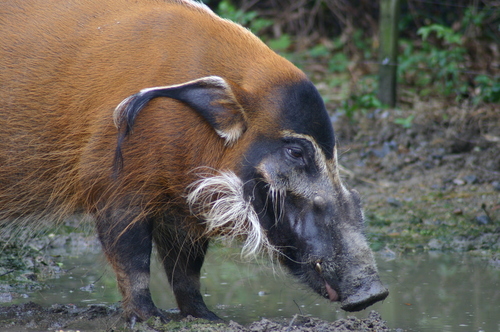
Red River Hog
Potamochoerus porcus
The most colorful of all wild pigs, the Red River Hog is a master of the African rainforest. With its striking orange coat and whimsical ear tassels, this social forager is a prize find for any trail camera enthusiast.
Quick Identification
Size
Length: 100-150 cm (3.3-4.9 ft); Height: 55-80 cm (22-31 in); Weight: 45-115 kg (100-250 lbs)
Colors
Brilliant reddish-orange to rufous coat with a prominent white stripe running down the spine. The face is black with white rings around the eyes and a white muzzle. Both sexes have long, white hair tassels on the tips of their ears.
Key Features
- Vibrant orange-red fur with a white dorsal stripe
- Long, tufted ear tassels
- White facial 'mask' markings
- Short, sharp tusks in both sexes
When You’ll See Them
Behavior
Red River Hogs are highly social creatures, typically living in small family groups known as 'sounders' led by a dominant male. These groups, often numbering between 6 and 20 individuals, are territorial and spend their time foraging through leaf litter and mud. While they can be active during the day in undisturbed areas, they are primarily nocturnal or crepuscular in regions where they face pressure from predators or human activity.
These pigs are excellent swimmers and are almost always found near water sources like rivers or marshes, which they use for cooling off and escaping threats. They communicate through a variety of grunts, squeals, and alarm whistles. While generally shy around humans, they can become quite bold if they discover a reliable food source like a forest plantation or farm edge.
EverydayEarth exclusive
Camera Tips
To capture the Red River Hog on camera, position your device low to the ground, roughly 20 to 30 inches (knee to waist height). Because they spend so much time rooting in the soil, an upward angle from a low position captures the most detail of their unique facial markings and ear tassels. Look for 'rooting' signs—disturbed soil and leaf litter—or well-worn game trails leading toward water sources or mud wallows.
Since these hogs are primarily active after dark, ensure your camera has a high-quality infrared flash with a fast trigger speed. They move in groups, so a single photo might only catch the leader; setting your camera to 'Burst Mode' or 'Video Mode' (15-30 seconds) is essential to capture the social dynamics of the entire sounder as they follow one another through the frame.
Baiting can be very effective if local regulations allow. They are particularly drawn to fermented fruit, corn, or even salt licks. If you aren't using bait, find a natural 'hotspot' like a fallen fruit tree (especially wild figs) or a muddy bank where they wallow to cool off. During the dry season, focusing your camera near permanent water holes is almost a guaranteed way to see them.
Placement is key for clarity. Avoid pointing the camera directly at thick brush, as the infrared flash may overexpose the foreground. Instead, aim across a small clearing or along the edge of a riverbank. If you are lucky enough to have them visiting a garden edge, a wide-angle lens helps capture the full group without cutting off individuals on the periphery.
Similar Species
Species that look similar or are commonly confused with Red River Hog.
Frequently Asked Questions
Record Red River Hog at your habitat
Connect a camera to start building your own species record — AI identifies every visitor automatically.