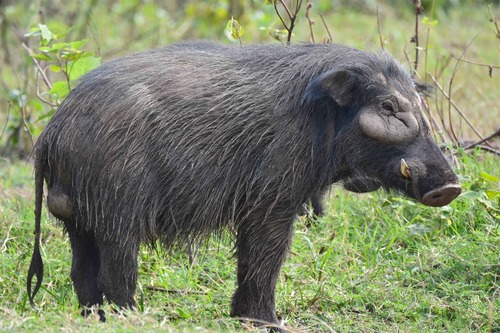
Giant Forest Hog
Hylochoerus meinertzhageni
Meet the 'Ghost of the Forest,' Africa's largest and most mysterious wild pig. With its massive size and shaggy black coat, the Giant Forest Hog is a true titan of the jungle that few ever see in the wild.
Quick Identification
Size
1.3 to 2.1 meters (4.3 to 6.9 feet) in length; weighs 130 to 275 kg (285 to 600 lbs)
Colors
Coarse, shaggy black or dark brown bristles covering greyish skin; older individuals may appear more sparsely haired
Key Features
- Massive head with broad, flat snout
- Extremely large, flared cheek pads in mature males
- Deep slit-like preorbital glands below the eyes
- Dense, bristly black hair and a prominent dorsal mane
When You’ll See Them
Geographic range
Where Does the Giant Forest Hog Live?
Native to the lush heart of the African continent, the Giant Forest Hog occupies a fragmented range across the equatorial belt. You can find these massive mammals from the humid lowland forests of West Africa, through the vast Congo Basin, and as far east as the high-altitude montane forests of Kenya and Ethiopia. While their distribution is patchy, they are most concentrated in protected national parks within Uganda, Gabon, and the Democratic Republic of the Congo.
Basemap © OpenStreetMap contributors
Behavior
In areas where they are not disturbed by human activity, these hogs are primarily diurnal, emerging to forage in the early morning and late afternoon. However, in regions with high hunting pressure, they quickly adapt to a nocturnal lifestyle to avoid detection. They are known for their intelligence and defensive nature; a dominant male will fiercely protect his group from predators like leopards or hyenas using his massive weight and sharp tusks.
EverydayEarth exclusive
Camera Tips
To capture a Giant Forest Hog on your trail camera, placement is everything. These animals are creatures of habit and use the same trails—often appearing as literal tunnels through the brush—for generations. Position your camera at 'knee height' (about 60-80 cm off the ground) and angle it slightly upward to account for their massive shoulder height. Because they are shy, avoid placing cameras in wide-open clearings; instead, focus on the edges where forest meets meadow or near active wallows where they cool off during the heat of the day.
Lighting can be a challenge in their dense forest habitats. Use a camera with a high-quality infrared flash to capture their dark coats at night without spooking them. Since these hogs move in groups, set your camera to 'Burst Mode' or 'Video Mode' with at least a 20-second duration. This ensures you catch the entire sounder passing through, rather than just the lead male or a single straggler. Avoid using high-glow LEDs if possible, as mature males can be wary of artificial light sources.
While baiting is often restricted in wild areas, these hogs are naturally drawn to mineral licks and salt deposits. If you are on private land where it is permitted, a salt block can be an effective lure. Keep in mind that these animals are sensitive to human scent; when checking your camera or swapping SD cards, wear gloves and minimize your time at the site. The best time to see them is during the rainy season when they are more active throughout the day and frequently visit forest openings to graze on fresh shoots.
Similar Species
Species that look similar or are commonly confused with Giant Forest Hog.
Red River Hog
Much smaller with a striking orange-red coat and long white ear tassels, unlike the Giant Forest Hog's solid black bristles.
Bushpig
Smaller and more varied in color, the bushpig has more pointed ears and lacks the massive, flared cheek pads of the Giant Forest Hog.
Common Warthog
Prefers open savanna, has prominent facial warts, and holds its tail straight up when running, which the Giant Forest Hog does not do.
Frequently Asked Questions
Record Giant Forest Hog at your habitat
Connect a camera to start building your own species record — AI identifies every visitor automatically.