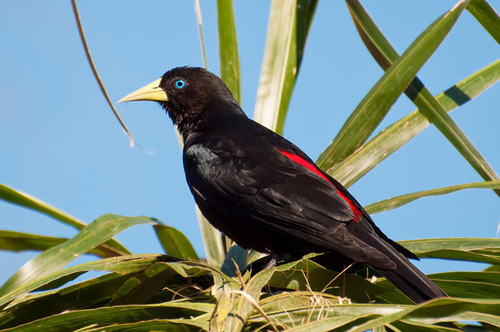
Red-rumped Cacique
Cacicus haemorrhous
A master of mimicry with a flash of fire on its back, the Red-rumped Cacique brings a touch of tropical drama to any backyard. Watch for its piercing blue eyes and listen for its incredible repertoire of stolen songs.
Quick Identification
Size
23–30 cm (9–12 in) in length; weighs 70–110g (2.5–3.9 oz). Males are noticeably larger and heavier than females.
Colors
Deep glossy black body with a brilliant scarlet-red patch on the lower back and rump. Features a pale ivory or greenish-yellow bill and striking pale blue or white irises.
Key Features
- Glossy jet-black plumage with a vivid red rump
- Pointed ivory-colored bill
- Piercing pale blue or white eyes
- Long, bag-like woven nests hanging in colonies
When You’ll See Them
Behavior
In the backyard setting, they are energetic and inquisitive. While they spend much of their time in the canopy, they are not shy about descending to lower levels if food or water is available. They exhibit a fascinating social hierarchy, particularly among males who perform elaborate bowing displays and wing-shivering to attract mates during the breeding season. Their presence is usually marked by a constant stream of whistles, squawks, and chattering.
EverydayEarth exclusive
Camera Tips
To capture the Red-rumped Cacique on camera, height is your best friend. These birds are canopy dwellers by nature, so mounting your AI-powered camera 10 to 15 feet up in a tree or on a second-story balcony overlooking the garden will yield the best results. If you are restricted to ground-level mounting, aim your camera upward at a 45-degree angle toward a known perching branch or a tall bird bath. They are creatures of habit and will often use the same 'staging' branches before descending to feed.
While they don't frequent standard seed feeders, you can successfully lure them into your camera's field of view using 'fruit-spiking.' Secure halved oranges, overripe bananas, or chunks of papaya to a platform feeder or even directly onto a tree limb using floral wire. The bright colors of the fruit act as a visual attractant. Position the camera about 5-8 feet away from the fruit to ensure the AI can clearly distinguish the bird's ivory bill and blue eyes against its dark feathers.
Lighting is critical for this species because their black plumage can easily become a 'black hole' in digital photos. Try to position your camera so the sun is behind it during the morning hours. This 'front-lighting' will illuminate the iridescence of their feathers and make the scarlet rump patch pop. If your camera has adjustable settings, a slightly faster shutter speed is recommended, as caciques are restless and prone to sudden, jerky movements.
Finally, keep an eye out for their nesting sites. If you have a colony in or near your yard, place a camera with a wide-angle lens focused on the hanging nests. The activity during the morning 'rush hour'—with birds flying in and out with nesting material or food for chicks—provides some of the most compelling wildlife footage you can find in South American backyards.
Similar Species
Species that look similar or are commonly confused with Red-rumped Cacique.
Frequently Asked Questions
Record Red-rumped Cacique at your habitat
Connect a camera to start building your own species record — AI identifies every visitor automatically.