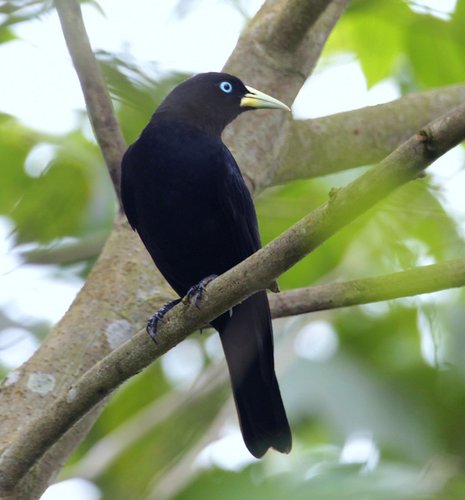
Scarlet-rumped Cacique
Cacicus uropygialis
A master of mimicry with a hidden flash of crimson, the Scarlet-rumped Cacique is the charismatic socialite of the tropical forest edge. Watch for its piercing blue eyes and ivory bill as it weaves its way through the canopy in noisy, energetic groups.
Quick Identification
Size
Length: 23–30 cm (9–12 in); Weight: 55–80 g (1.9–2.8 oz)
Colors
Jet-black plumage across the entire body, except for a vibrant scarlet-red patch on the lower back (rump). Features a pale ivory bill and striking pale blue eyes.
Key Features
- Glossy black plumage with a hidden scarlet rump patch
- Pale ivory or yellowish-white pointed bill
- Distinctive pale blue eyes
- Long, wedge-shaped tail
When You’ll See Them
Behavior
The Scarlet-rumped Cacique is a highly social and vocal member of the Icterid family, often found traveling in small, lively groups through the mid-canopy and forest edges. They are renowned for their remarkable mimicry, weaving together the calls of other birds and environmental sounds into complex, liquid songs that can be heard from a distance. While they are naturally birds of the forest, they are bold and curious, frequently venturing into clearings and gardens in search of food.
During the breeding season, these birds exhibit fascinating nesting behavior, constructing long, pendulous bags woven from plant fibers that hang from the tips of branches. They are active and agile foragers, often seen hanging upside down to reach fruit or probing deep into bromeliads for insects. Their social nature means that if you see one, several more are likely nearby, maintaining constant chatter to keep the group together.
EverydayEarth exclusive
Camera Tips
To successfully capture the Scarlet-rumped Cacique on a trail camera, you must account for their preference for the mid-to-upper canopy. If you are setting up in a backyard, mount your camera at least 8 to 12 feet high, angled slightly downward toward a known perching branch or a high-platform feeder. These birds are creatures of habit and will often use the same 'scouting' branch before descending to eat or drink. Look for branches that offer a clear line of sight and are illuminated by the morning sun.
Baiting is highly effective for this species. Set up a platform feeder stocked with overripe bananas, halved papayas, or oranges. Because they are also nectar drinkers, placing your camera near flowering shrubs like Hibiscus or Heliconia can result in stunning action shots. To keep them in the frame longer, try securing fruit inside a suet cage; this forces the bird to stay and 'work' for the food rather than grabbing a piece and flying away immediately.
Technical settings are critical because of their dark plumage. Black birds often appear as featureless silhouettes in harsh light. Position your camera so the sun is behind it, illuminating the bird directly. Increase your exposure compensation by +0.5 or +1.0 to bring out the detail in their black feathers and the texture of their ivory bill. Use a fast trigger speed or high-frame-rate video (60fps), as their movements are jerky and fast, and the brilliant scarlet rump is often only visible for a split second when they flick their wings or take flight.
Similar Species
Species that look similar or are commonly confused with Scarlet-rumped Cacique.
Frequently Asked Questions
Record Scarlet-rumped Cacique at your habitat
Connect a camera to start building your own species record — AI identifies every visitor automatically.