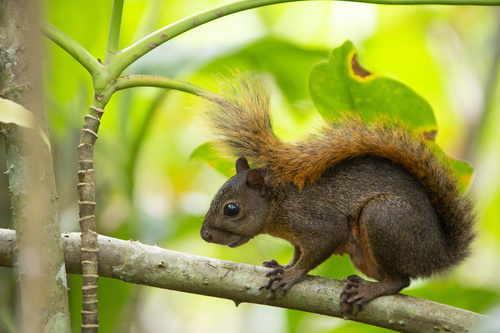
Red-tailed Squirrel
Sciurus granatensis
With its fiery orange tail and incredible acrobatics, the Red-tailed Squirrel is the vibrant acrobat of the tropical canopy. Discover how this adaptable mammal brings a splash of color and energy to backyards and forests alike.
Quick Identification
Size
Total length of 33–52 cm (13–20.5 in); weight ranges from 212 to 520 g (7.5–18.3 oz)
Colors
Rich reddish-brown or olive-brown upperparts; underparts range from white to deep orange; tail is long, bushy, and characteristically bright red or orange, often with a black tip.
Key Features
- Long, bushy tail with distinctive red or orange coloring
- Prominent ears without tufts
- Vivid white or orange underbelly contrasting with dark back
- Highly agile arboreal movement
When You’ll See Them
Sightings on EverydayEarth
Jul 28, 2026
A variety of tropical birds, including Blue-gray Tanagers, a Bananaquit, and a Palm Tanager, are seen feeding on an assortment of fruit at the platform. A Clay-colored Thrush remains stationary on a nearby branch. The peaceful feeding session is interrupted when a Red-tailed Squirrel suddenly vaults onto the tray from below, causing the birds to quickly take flight as the squirrel begins to inspect the fruit.
Apr 30, 2026
A Red-tailed Squirrel explores the fruit feeder, hopping across the moss-covered logs to reach the fresh papaya and orange slices. Its vibrant reddish-brown fur and bushy tail are clearly visible as it sniffs the food and moves quickly across the platform.
Apr 25, 2026
A Red-tailed Squirrel is perched on the mossy branch of the feeder, focused on eating a piece of fruit. It remains mostly stationary throughout the clip, with its characteristic bushy tail arched over its back.
Apr 14, 2026
A Red-tailed Squirrel is perched on the fruit feeder, hunched over and busily feeding on the provided oranges and bananas.
Apr 10, 2026
A Red-tailed Squirrel sits on a moss-covered branch at the feeding station, focused on eating a piece of fruit. It holds the food with its front paws and nibbles steadily while its long, vibrant tail hangs behind it. A light rain is falling, wetting the surrounding tropical plants and the feeder platform.
Apr 7, 2026
A Red-tailed Squirrel is perched on a mossy branch above the main feeding platform. It is focused on eating a piece of food held in its front paws, with its signature reddish-orange bushy tail curled over its back. The feeder below is stocked with fruit, including several orange halves, but the squirrel remains on the branch throughout the observation.
Behavior
The Red-tailed Squirrel is a remarkably active and agile tree-dweller, spending the majority of its time in the canopy. Unlike some of its North American cousins, this species is known for its adaptability, thriving in everything from dense rainforests to suburban gardens and coffee plantations. They are primarily solitary, though you might spot multiple individuals congregating near a particularly bountiful fruit tree or during the breeding season when males engage in high-speed chases through the branches.
In suburban settings, these squirrels can become quite bold, frequently visiting bird feeders or fruit trees in backyards. They are vocal creatures, using a series of chirps and chatters to signal alarms or defend their territory. Their movement is fluid and fast, making them a delight to watch as they leap between branches with their rudder-like tails providing perfect balance.
EverydayEarth exclusive
Camera Tips
To capture the Red-tailed Squirrel on your AI camera, height is everything. Since they are predominantly arboreal, mounting your camera 5 to 10 feet up a sturdy tree trunk or along a fence line provides a much better perspective than ground-level placement. Angle the camera slightly downward toward a flat branch or a platform feeder to capture clear, eye-level shots of them foraging. Because they move with lightning speed, ensure your camera is set to a high trigger speed or 'Burst Mode' to catch them mid-leap rather than just a blurry tail exiting the frame.
Luring these squirrels is relatively simple if you have fruiting trees or palms nearby. If you don't, a small amount of peanut butter smeared on tree bark or a handful of native nuts can work wonders. In suburban areas, they are often drawn to sunflower seeds or corn provided for birds. Positioning the camera near a water source, such as a raised birdbath, is also highly effective, especially during the dry season when natural water sources in the canopy might be scarce.
Lighting is a critical factor for getting the best color out of their fiery tails. Try to position your camera so it faces away from the direct morning sun to avoid silhouetting. A spot with dappled sunlight through the leaves often provides the most natural and vibrant look. Since they are strictly diurnal, you can save battery life by setting your camera's schedule to only record during daylight hours, focusing specifically on the first few hours after sunrise when their activity levels are at their absolute peak.
Similar Species
Species that look similar or are commonly confused with Red-tailed Squirrel.
Variegated Squirrel
Larger with highly variable coat colors (often gray, black, or white) compared to the more consistent reddish-brown tones of the Red-tailed Squirrel.
Deppe's Squirrel
Much smaller and more drab in color, usually a uniform brownish-gray without the vibrant red tail characteristic of Sciurus granatensis.
Frequently Asked Questions
Record Red-tailed Squirrel at your habitat
Connect a camera to start building your own species record — AI identifies every visitor automatically.