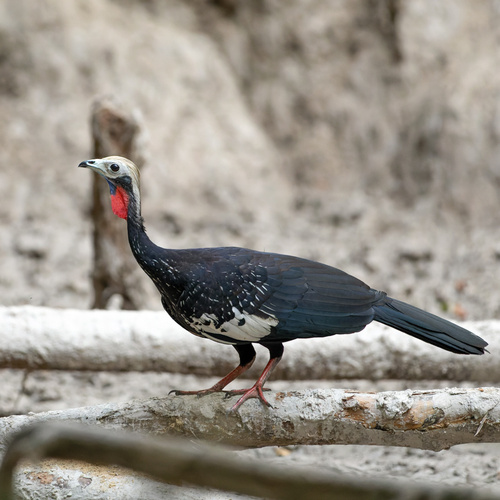
Red-throated Piping-Guan
Pipile cujubi
A striking arboreal bird of the Amazon, the Red-throated Piping-Guan stands out with its brilliant white crest and vivid red throat. Watch for its unique 'wing-drumming' displays in the early morning canopy.
Quick Identification
Size
69-76 cm (27-30 inches) in length; weight approximately 1.1-1.3 kg (2.4-2.9 lbs)
Colors
Glossy black body with a prominent white crest and large white wing patches; distinctive bright red fleshy throat wattle; pale blue facial skin.
Key Features
- Large bushy white crest
- Bright red hanging throat wattle
- Prominent white patches on wings
- Blue skin around the eyes
- Long, broad tail
When You’ll See Them
Geographic range
Where Does the Red-throated Piping-Guan Live?
Native to the lush tropical regions of South America, the Red-throated Piping-Guan is found primarily within the southern Amazon Basin. Its core range encompasses a vast area of central and northern Brazil, stretching southward into the lowland plains of northern and eastern Bolivia. These birds are highly dependent on intact riverine ecosystems and dense primary forests that provide a year-round supply of fruit.
Basemap © OpenStreetMap contributors
Behavior
The Red-throated Piping-Guan is a social and predominantly arboreal bird, spending the majority of its life in the mid-to-upper canopy of the tropical rainforest. They are often seen in pairs or small family groups, moving with surprising agility through the branches by hopping and gliding. One of their most fascinating behaviors is the 'wing-drumming' display performed at dawn, where they fly between trees and use their wings to create a rhythmic, mechanical sound to signal their presence.
While they are naturally cautious, they are generally less shy than other members of the Cracidae family if they are not actively hunted. They follow a daily routine, moving from roosting sites to favored fruiting trees early in the morning and again in the late afternoon. Though they prefer the safety of the heights, they will occasionally descend to the ground to drink water or visit salt licks, where they remain highly alert to potential predators like jaguars or large raptors.
EverydayEarth exclusive
Camera Tips
Capturing the Red-throated Piping-Guan on camera requires focusing on their vertical environment. Because they are canopy-dwellers, a ground-level camera will rarely catch them unless placed near a known water source or a mineral lick. Look for areas where the forest floor meets a river or stream; these birds often descend to the same spots daily to drink. Mount your camera about 3-5 feet off the ground, angled slightly upward to capture them as they land on lower branches before approaching the water.
If you have access to a platform or can safely mount a camera in the mid-canopy (15-30 feet up), aim for trees currently in fruit, such as wild figs or various palms. These 'grocery stores' of the rainforest are the best places to observe their feeding social dynamics. Use a fast trigger speed, as their movements between branches can be rapid and jerky, and set your camera to take 3-5 photo bursts to ensure you get a clear shot of the distinctive red throat wattle and white crest.
Since the Amazonian understory is often dark, a camera with high-quality low-light performance or a subtle 'no-glow' infrared flash is ideal to avoid spooking the birds during their early morning activity. In the early morning, listen for the mechanical 'whirring' of their wings; this is a clear indicator that they are active in the area. Check your cameras frequently during the peak of the dry season when water sources are limited, as this is when they are most likely to visit the forest floor.
Similar Species
Species that look similar or are commonly confused with Red-throated Piping-Guan.
Blue-throated Piping-Guan
Features a cobalt blue throat wattle instead of red and is found further west and south in South America.
Razor-billed Curassow
Much larger and heavier with a massive, bright red arched bill and lacks the white crest and wing patches.
Spix's Guan
Lacks the white crest and large white wing patches, having a more uniform dark brown or grey appearance.
Frequently Asked Questions
Record Red-throated Piping-Guan at your habitat
Connect a camera to start building your own species record — AI identifies every visitor automatically.