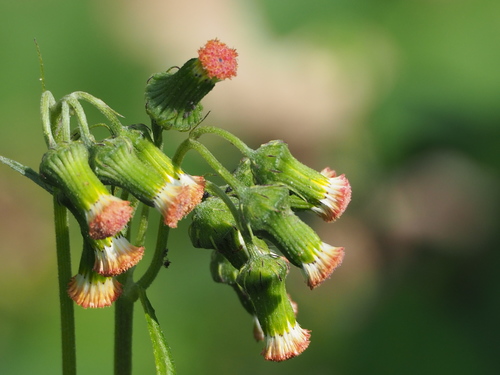
redflower ragleaf
Crassocephalum crepidioides
A resilient traveler from Africa, the redflower ragleaf is a striking succulent herb known for its nodding crimson blooms and dandelion-like seed puffs.
Quick Identification
Size
Grows 40–180 cm (1.3–6 feet) in height; leaves are 5–20 cm (2–8 inches) long.
Colors
Bright to dark green succulent stems and leaves; flower heads are cylindrical with reddish-orange or pinkish-brown tips and white feathery pappus.
Key Features
- Nodding flower heads that hang downward before maturity
- Erect, succulent stems that can reach 6 feet
- Deeply lobed or coarsely toothed green leaves
- Tufts of silky white hairs (pappus) for wind-dispersed seeds
- Cylindrical flower clusters without visible petals
When You’ll See Them
Geographic range
Where Does the redflower ragleaf Live?
Originally native to the tropical regions of Africa, the redflower ragleaf has successfully expanded its territory across the globe to become a cosmopolitan resident of many subtropical and tropical zones. It is now widely established throughout Southeast Asia, Australia, and the Pacific Islands, where it is often considered a naturalized weed or a wild vegetable. In recent decades, it has also been spotted in the warmer regions of the Americas, thriving in human-modified landscapes from roadside ditches to manicured backyards.
Basemap © OpenStreetMap contributors
Behavior
The redflower ragleaf is a fast-growing annual herb known for its opportunistic behavior, quickly colonizing disturbed soil, backyard gardens, and forest edges. Unlike many wildflowers that stand upright to display their blooms, this species is famous for its "nodding" habit; the flower heads often droop toward the ground until they are ready to release their seeds. It is a pioneer species, meaning it is often one of the first plants to appear after soil has been turned or cleared.
In the backyard ecosystem, the redflower ragleaf plays a vital role as a food source for various pollinators. While its flowers may look closed or inconspicuous, they are frequently visited by bees and small butterflies. Once pollination is complete, the nodding heads straighten up and transform into fluffy white globes, similar to dandelions, allowing the wind to carry hundreds of seeds to new locations. It is highly resilient and thrives in nitrogen-rich environments, such as compost piles or heavily mulched garden beds.
EverydayEarth exclusive
Camera Tips
Capturing the redflower ragleaf on an AI-powered backyard camera offers a fascinating look at plant movement and insect interactions. To get the best results, place your camera on a low-profile mount or small tripod about 2 feet off the ground, angled slightly upward. This angle highlights the unique "nodding" flower heads against the sky and ensures the camera captures the transition from red-tipped buds to white, fluffy seed heads.
Because this plant can grow quite tall, you should monitor its growth weekly and adjust your camera height accordingly. The most interesting footage often comes from time-lapse settings; try setting your camera to take a photo every 15 to 30 minutes. This will allow you to see the "circumnutation" (the slow, circular dancing movement of the stems) and the dramatic way the flower heads lift and straighten as they turn into seed puffs.
To capture the wildlife that visits the redflower ragleaf, use a high-sensitivity trigger setting. While the plant itself is stationary, it is a magnet for small pollinators like hoverflies and skippers, especially in the mid-morning hours between 9 AM and 11 AM. Positioning your camera on the eastern side of the plant will provide the best natural lighting for morning visitors. Avoid using heavy baits near the plant, as you want to capture the natural behavior of insects attracted specifically to the ragleaf's nectar.
Similar Species
Species that look similar or are commonly confused with redflower ragleaf.
Frequently Asked Questions
Record redflower ragleaf at your habitat
Connect a camera to start building your own species record — AI identifies every visitor automatically.