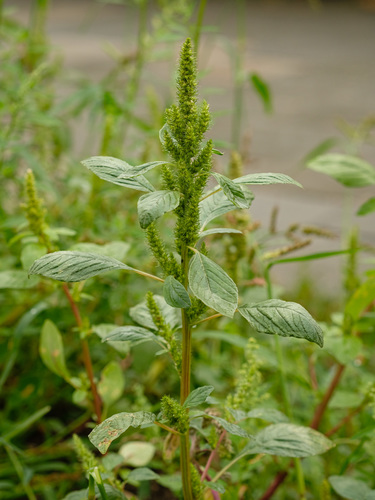
Redroot Amaranth
Amaranthus retroflexus
The Redroot Amaranth is a hardy survivor and a backyard bird feeder designed by nature. With its striking pink roots and towering seed spikes, it turns disturbed soil into a bustling hub for local wildlife.
Quick Identification
Size
Typically 0.5–2 meters (1.5–6.5 feet) tall; leaves reach 5–15 cm (2–6 inches) in length.
Colors
Dull green leaves with light-colored veins; stems are light green to reddish; distinctive pink or red taproot.
Key Features
- Vibrant red or deep pink taproot
- Bristly, dense clusters of tiny green flowers at the stem tips
- Rough, hairy stems particularly near the flower spikes
- Broad, diamond-shaped leaves with wavy margins
When You’ll See Them
Behavior
Redroot Amaranth is a prolific annual herb known for its incredible resilience and rapid growth. Often dismissed as a common weed, it plays a vital role in the ecosystem as a 'pioneer species,' quickly colonizing disturbed soil where other plants struggle. It is a master of reproduction, with a single healthy plant capable of producing over 100,000 tiny, protein-rich seeds that provide a critical food source for ground-feeding birds during the lean months of late autumn.
While it doesn't move in the traditional sense, Redroot Amaranth exhibits fascinating daily rhythms. Its leaves often change orientation throughout the day to maximize sun exposure, a process known as solar tracking. In suburban environments, it is frequently found in the margins of gardens or along fence lines, where it interacts with humans primarily as a competitor for garden space, though many foragers value its edible young leaves and nutritious seeds.
EverydayEarth exclusive
Camera Tips
To capture the true essence of Redroot Amaranth with an AI-powered camera, time-lapse is your best friend. Because plants grow at a pace the human eye misses, setting your camera to take a photo every hour over the course of a week in July or August will reveal the plant’s dramatic vertical 'stretch' and the unfolding of its bristly flower spikes. If your camera supports a 24-hour cycle, you can also observe nyctinasty—the way the leaves subtly droop or change angle during the night to conserve moisture and heat.
Placement is key for wildlife interaction. Instead of pointing your camera at the ground, mount it on a stake approximately 3 to 4 feet high, angled slightly downward toward the mature seed heads. In late summer and early fall, these spikes become high-traffic zones for songbirds like American Goldfinches and Dark-eyed Juncos. Use a 'motion-trigger' setting with high sensitivity to catch these light-footed birds as they cling to the stalks to feast on the seeds. These plants can be quite tall, so ensure your camera is far enough back to keep the entire flowering structure in the frame.
For a unique perspective, consider a low-angle shot during the early morning. If you have recently weeded or tilled a patch of soil, the 'red root' that gives the plant its name may be partially exposed. Positioning the camera near the base of the plant can capture the contrast between the vibrant pinkish-red root and the pale green stem. Early morning light (the golden hour) is particularly effective for highlighting the fine, bristly hairs (trichomes) on the stem, which can give the plant a glowing, halo-like appearance in photos.
Finally, keep an eye on the weather. Redroot Amaranth is remarkably sturdy, but its broad leaves capture rain and dew beautifully. Setting your camera to capture macro-style shots after a summer rain can yield stunning high-definition images of water beads resting on the wavy leaf margins. In late autumn, don't remove the plant immediately; keep your camera active to document the 'skeleton' of the plant as it turns brown, providing a structural perch for wintering birds and a focal point for frost photography.
Similar Species
Species that look similar or are commonly confused with Redroot Amaranth.
Frequently Asked Questions
Record Redroot Amaranth at your habitat
Connect a camera to start building your own species record — AI identifies every visitor automatically.