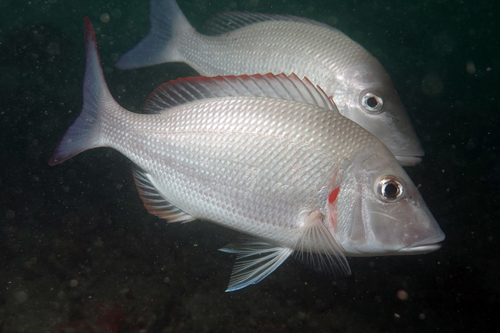
Redspot Emperor
Lethrinus lentjan
The Redspot Emperor is the inquisitive 'pink-eared' scavenger of the Indo-Pacific, famous for its striking red gill markings and its bold, patrolling presence over sandy reef floors.
Quick Identification
Size
Typically 30-50 cm (12-20 inches) in length; weight up to 2 kg (4.4 lbs)
Colors
Silvery-grey to olive-green body with a signature bright red or pink spot on the posterior edge of the gill cover
Key Features
- Bright red spot on the operculum margin
- Pinkish base of the pectoral fins
- Elongated, pointed snout with thick lips
- Large, high-set eyes with a golden iris
When You’ll See Them
Geographic range
Where Does the Redspot Emperor Live?
The Redspot Emperor is a widespread resident of the tropical Indo-West Pacific. Its vast territory begins in the Red Sea and along the East African coast, stretching across the Indian Ocean to the islands of Southeast Asia and the Coral Triangle. It is commonly found throughout the Great Barrier Reef in Australia and extends as far north as the Ryukyu Islands of Japan and east toward the island nations of Tonga and Fiji.
Basemap © OpenStreetMap contributors
Behavior
The Redspot Emperor is a highly active and inquisitive marine fish, frequently observed patrolling the sandy peripheries of coral reefs. While younger individuals are known to congregate in large, protective schools within shallow seagrass beds and mangrove estuaries, mature adults tend to lead more solitary lives or travel in small, loose groups as they move into deeper lagoon waters and coastal reef slopes.
These fish are known for their bold personality; they are often among the first species to investigate disturbances on the seabed, looking for an easy meal uncovered by shifting sands. They spend much of their day hovering just above the substrate, using their keen eyesight to spot movement and their powerful jaws to excavate prey. Unlike some more territorial reef residents, they are somewhat nomadic within their local reef system, moving according to the tides and food availability.
EverydayEarth exclusive
Camera Tips
Capturing the Redspot Emperor on camera requires an underwater setup, such as an action camera in a waterproof housing or a specialized submersible trail cam. For the best results, position your camera on a weighted tripod on the sandy floor adjacent to a coral reef. Aim the lens horizontally or with a slight downward tilt, as these fish spend most of their time scanning the substrate for food. Placing the camera near a 'cleaning station'—where small wrasse remove parasites from larger fish—is an excellent way to get steady, close-up shots of a stationary Emperor.
To increase your chances of a sighting, use a scent-based attractant. A perforated PVC pipe or mesh bag filled with crushed crabs or oily fish bait can be anchored just in front of the camera. The Redspot Emperor’s inquisitive nature and excellent sense of smell will draw it toward the bait, often resulting in footage of the fish using its snout to nudge the container. Because they are diurnal, ensure your camera is set to record during peak daylight hours; the natural light will help illuminate the vibrant red spot on their gill cover which can look dull in low-light conditions.
If you are setting up your camera in deeper water (beyond 5 meters), consider using an external light source or a red filter lens. In the blue-heavy environment of the ocean, the Redspot Emperor’s distinctive red markings are the first colors to disappear, often appearing grey or black in standard footage. A high frame rate of 60fps or higher is recommended, as these fish are capable of sudden, lightning-fast bursts of speed when they detect prey or a potential threat.
Similar Species
Species that look similar or are commonly confused with Redspot Emperor.
Frequently Asked Questions
Record Redspot Emperor at your habitat
Connect a camera to start building your own species record — AI identifies every visitor automatically.