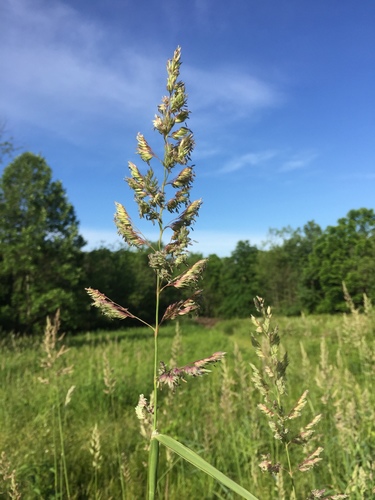
reed canary grass
Phalaris arundinacea
A towering presence in the wetlands, reed canary grass creates lush, waving meadows that define the water's edge. Its aggressive growth and unique flowering spikes make it a fascinating study in resilience and adaptation.
Quick Identification
Size
2 to 9 feet (0.6 to 2.8 meters) tall with leaf blades up to 10 inches (25 cm) in length
Colors
Bright blue-green foliage during growth; flower heads transition from green/purple to a tan or straw color when mature
Key Features
- Transparent, papery ligule where the leaf meets the stem
- Dense, branched flower clusters (panicles) that can reach 10 inches long
- Hollow, sturdy, bamboo-like stems
- Thick, mat-forming underground rhizomes
When You’ll See Them
Behavior
Reed canary grass is a highly energetic and aggressive perennial that is famous for its ability to dominate wetland ecosystems. It spreads through a sophisticated network of underground stems called rhizomes, which allow it to form dense, single-species stands. This growth habit is so effective that it often crowds out native wildflowers and other grasses, creating a sea of uniform green along riverbanks and marshes.
In the backyard or suburban landscape, this grass acts as a biological filter, thriving in areas with high nutrient runoff from fertilizers or septic systems. While it provides excellent cover for small mammals like voles and nesting sites for certain waterfowl, its rapid expansion can be a challenge for gardeners. It is one of the first plants to emerge in the spring, making it a reliable indicator of the changing seasons.
EverydayEarth exclusive
Camera Tips
Reed canary grass is an ideal subject for time-lapse photography. To capture its impressive growth spurt in the spring, mount your camera on a T-post or a sturdy stake at a height of about 4 feet, angled slightly downward. Set your camera to 'Time-Lapse' mode with an interval of one photo every 4 to 6 hours. Over the course of a month, you will see the grass 'crawl' across the frame as its rhizomes expand and the stalks shoot upward toward the sun.
If you are using a motion-triggered camera to spot wildlife, look for 'tunnels' within the grass. Small mammals like muskrats, rabbits, and voles create hidden paths through the dense stalks to avoid predators. Place your camera very low to the ground—about 6 inches up—and aim it down the length of these tunnels. Be sure to trim away any blades of grass within 12 inches of the lens, as reed canary grass catches the wind easily and will cause hundreds of false triggers on a breezy day.
For the most aesthetic shots of the seed heads, use the early morning light. The dense panicles are excellent at catching morning dew and spider webs. If your camera allows for manual focus or macro-style shots, try to capture the grass during the 'golden hour' (the first hour after sunrise). The backlighting will illuminate the fine hairs and structures of the flowering heads, turning a common 'weed' into a stunning piece of nature photography.
Similar Species
Species that look similar or are commonly confused with reed canary grass.
Frequently Asked Questions
Record reed canary grass at your habitat
Connect a camera to start building your own species record — AI identifies every visitor automatically.