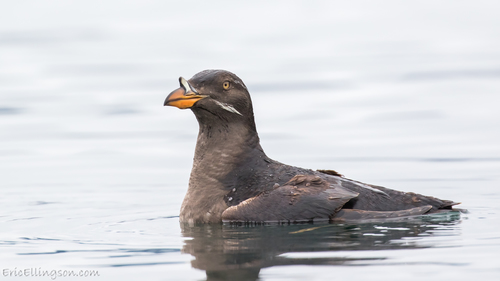
Rhinoceros Auklet
Cerorhinca monocerata
Meet the 'Rhino of the Sea,' a mysterious nocturnal relative of the puffin that nests in underground forest burrows and sports a unique facial horn during the summer months.
Quick Identification
Size
Length: 35–38 cm (14–15 in); Wingspan: 57–65 cm (22–26 in); Weight: 450–550 g (1–1.2 lbs)
Colors
Sooty-grey to dark brown upperparts with paler grey underparts; breeding adults feature a yellowish-orange bill and two distinct white facial plumes.
Key Features
- Vertical 'horn' at the base of the bill during breeding season
- Two thin white facial plumes behind the eye and from the bill corner
- Stocky, puffin-like body with a thick neck
- Orange-yellow bill with a darker culmen
When You’ll See Them
Geographic range
Where Does the Rhinoceros Auklet Live?
Where Does the Rhinoceros Auklet Live? This resilient seabird is a true North Pacific specialist, spanning the temperate and subarctic waters of the northern hemisphere. On the western side, they are found from Japan and the Korean Peninsula up through the Kuril Islands and the coast of Russia. Across the eastern Pacific, their range extends from the Aleutian Islands of Alaska southward along the coast of British Columbia and the United States, reaching as far south as the Channel Islands in California during the breeding season.
Basemap © OpenStreetMap contributors
Behavior
Rhinoceros Auklets are often referred to as the 'nocturnal puffin.' Unlike their more famous cousins, they are highly secretive on land, primarily visiting their breeding colonies under the cover of darkness. This nocturnal behavior is a specialized strategy to avoid kleptoparasitism—a fancy way of saying they don't want gulls or eagles stealing the fish they’ve worked hard to catch for their chicks.
At sea, they are social birds but tend to forage in small groups rather than massive rafts. They are incredible pursuit-divers, using their wings to literally fly through the water in search of schooling fish. While they can be seen during the day on the open ocean, they remain cautious and will dive or fly away if a vessel approaches too closely. On land, they are clumsy but determined, often crash-landing into the undergrowth before scurrying into their underground burrows.
EverydayEarth exclusive
Camera Tips
Capturing Rhinoceros Auklets requires a specialized approach because they spend their nights on land and their days at sea. If you have access to a coastal property or island near a colony, the 'golden ticket' is locating their burrow entrances. Look for 4-6 inch wide holes in the soil, often tucked under the roots of Sitka spruce or hidden by sword ferns. Position your camera 12-18 inches off the ground, angled slightly downward toward the entrance. Because these birds only visit at night, a camera with high-quality 'No-Glow' infrared LEDs is mandatory to prevent startling the birds or attracting predators like raccoons or eagles to the burrow.
Set your camera to video mode or a 3-shot burst with the fastest possible trigger speed. These birds 'crash-land' near their burrows and move surprisingly fast across the forest floor to avoid detection. High-speed video is especially rewarding because it captures the frantic, comical way they scurry with a bill full of fish. Since the fish themselves are often silvery and reflective, try to reduce your camera's flash intensity if possible to avoid 'white-out' on the most interesting part of the shot.
For those monitoring from the shore or a pier, a camera aimed at the water line during the pre-dawn hours (4 AM to 6 AM) can catch them as they gather before heading out to sea. However, land-based burrow shots remain the most reliable way to get high-quality images. Avoid using any scent lures or bait, as these birds respond only to the drive to feed their young and are highly sensitive to disturbances in their nesting habitat.
Similar Species
Species that look similar or are commonly confused with Rhinoceros Auklet.
Frequently Asked Questions
Record Rhinoceros Auklet at your habitat
Connect a camera to start building your own species record — AI identifies every visitor automatically.