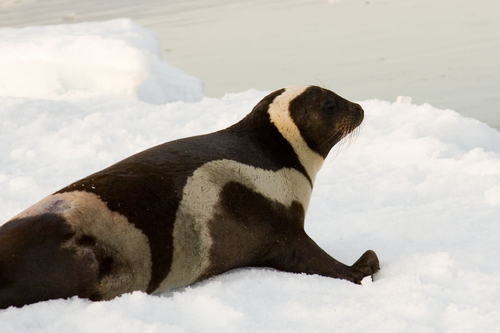
Ribbon Seal
Histriophoca fasciata
Wrapped in striking white bands that look like a gift from the Arctic, the Ribbon Seal is the North Pacific's most stylish and elusive resident. These deep-diving 'ocean ninjas' spend their lives navigating the shifting pack ice of the Bering Sea.
Quick Identification
Size
1.6 to 1.9 metres (5.2 to 6.2 feet) long; 70 to 150 kg (154 to 330 lbs)
Colors
Adults are dark brown to black with four distinctive wide white bands: one around the neck, one around the tail, and a circular loop on each side.
Key Features
- Four bold white ribbon-like bands on a dark body
- Large, dark eyes and a relatively small, blunt snout
- Solitary behavior, rarely forming large colonies
- Uniquely elongated lungs and specialized internal air sacs
When You’ll See Them
Geographic range
Where Does the Ribbon Seal Live?
The Ribbon Seal is a true specialist of the icy North Pacific, primarily inhabiting the remote waters of the Bering Sea and the Sea of Okhotsk. These elusive seals are native to the high latitudes of North America and Asia, with their core range spanning from the coastal waters of Alaska in the United States to the far eastern shores of Russia and northern Japan. While they spend much of their lives in the open ocean, they are most frequently spotted during the spring and early summer when they haul out onto the drifting pack ice to molt and give birth.
Basemap © OpenStreetMap contributors
Behavior
The Ribbon Seal is one of the most elusive and solitary pinnipeds in the world. Unlike many other seal species that congregate in massive, noisy rookeries, Ribbon Seals prefer the isolation of the drifting pack ice in the North Pacific. They are exceptionally agile on the ice, moving with a distinctive side-to-side rowing motion that is much faster than the typical belly-scooting of other true seals. This agility helps them navigate the treacherous edges of ice floes where they haul out to rest, molt, and give birth.
These seals are deep-sea specialists, capable of diving to depths of up to 600 meters in search of food. They spend the vast majority of their lives in the open ocean (pelagic), only coming to the ice during the spring and early summer months. They are generally wary of humans and predators like polar bears or orcas, often slipping silently into the water at the first sign of a disturbance. Because they live so far from human settlements, their social interactions remain a mystery to most researchers.
EverydayEarth exclusive
Camera Tips
Capturing a Ribbon Seal on camera is a challenge that requires venturing into remote Arctic environments. Because these seals do not visit backyards, you must deploy cameras on the drifting pack ice or along the rugged coastlines of the Bering Sea during the spring molting season. Use a rugged, waterproof trail camera with a high-speed trigger, as these seals can be surprisingly quick when transitioning from the ice into the water. Ensure your camera is secured to a stable surface, such as a large piece of heavy driftwood or a weighted tripod, as shifting ice and high winds are constant factors.
The lighting in snowy and icy environments is notoriously tricky. Set your camera to a slightly lower exposure or use an 'auto-HDR' mode if available to prevent the bright white 'ribbons' of the seal and the surrounding ice from becoming overexposed or 'blown out.' Because Ribbon Seals are solitary and wary, it is best to place cameras near natural 'haul-out' spots—smooth, accessible edges of ice floes that are protected from the heaviest surf. Avoid using artificial scents or baits, as these seals are primarily visual and tactile hunters and are unlikely to be lured by traditional terrestrial baits.
For the best results, utilize time-lapse mode during the daylight hours of the Arctic spring. Since these seals spend hours resting on the ice to molt, a time-lapse setting every 5-10 minutes can capture their slow movements and social behaviors that a standard motion trigger might miss. If you are using a camera with video capabilities, ensure it has a high-quality internal microphone; the sound of the pack ice shifting combined with the rare vocalizations of the seal can provide incredible context to your footage. Always maintain a respectful distance with remote equipment to avoid disturbing their natural resting cycles.
Similar Species
Species that look similar or are commonly confused with Ribbon Seal.
Harbor Seal
Lacks the bold ribbon patterns; has a more uniform mottled or spotted coat and a shorter muzzle.
Spotted Seal
Features numerous small dark spots over a lighter grey coat, rather than the wide white bands of the Ribbon Seal.
Harp Seal
Found in the Atlantic/Arctic, adults have a black 'harp' or wishbone shape on their backs rather than circular ribbons.
Frequently Asked Questions
Record Ribbon Seal at your habitat
Connect a camera to start building your own species record — AI identifies every visitor automatically.