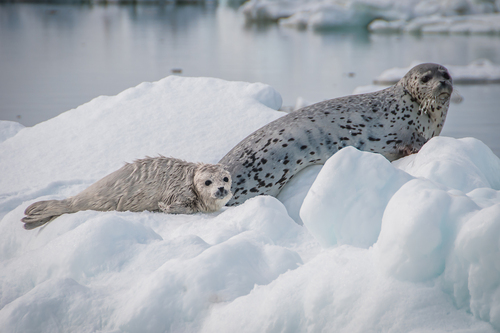
Spotted Seal
Phoca largha
The Spotted Seal is the speckled sentinel of the North Pacific. Perfectly adapted for life on the edge of the ice, these master divers are as much at home on a floating floe as they are in the deep blue.
Quick Identification
Size
Length: 1.5–1.7 meters (4.9–5.6 feet); Weight: 65–115 kilograms (143–254 pounds)
Colors
Pale silver-gray to yellowish-cream base coat with a dense pattern of irregular dark brown or black spots; pups are born with a snowy white lanugo coat
Key Features
- Dense pattern of small, dark irregular spots over the entire body
- Rounded, dog-like face with no external ear flaps
- V-shaped nostrils that almost touch at the base
- Robust, torpedo-shaped body adapted for icy waters
When You’ll See Them
Geographic range
Where Does the Spotted Seal Live?
Native to the North Pacific Ocean and its adjacent Arctic fringes, the Spotted Seal thrives along the vast continental shelves of the Bering, Chukchi, and Okhotsk Seas. Its range extends from the northern reaches of Alaska’s Bristol Bay westward to the coasts of Russia and south into the Sea of Japan and the Yellow Sea. While primarily found in North America and Asia, these seals are seasonally migratory, following the rhythmic advance and retreat of the winter ice pack to find the perfect breeding grounds.
Basemap © OpenStreetMap contributors
Behavior
Spotted Seals are highly social yet cautious marine mammals, often seen gathering in large groups on ice floes or remote coastal sandbars. Unlike their close relatives, the harbor seals, Spotted Seals are strongly associated with seasonal sea ice, which they use for mating, pupping, and molting. They are incredible divers, capable of reaching depths of 300 meters in search of food, though they typically hunt in shallower continental shelf waters.
While they are wary of humans and will quickly slip into the water if they perceive a threat, they exhibit fascinating social behaviors among their own kind. During the breeding season, they form 'triads' consisting of a female, her pup, and a protective male suitor. They are vocal creatures, communicating with a variety of growls, barks, and chirps that can often be heard echoing across the ice or water.
EverydayEarth exclusive
Camera Tips
Capturing Spotted Seals on camera requires a strategic approach focused on 'haul-out' sites—places where they leave the water to rest. If you live on a coastal property in their range, identify low-tide sandbars, flat rocky outcroppings, or estuaries they frequent. Place your camera on a sturdy tripod or mount it to a fixed structure like a pier or a coastal tree, ensuring it is positioned high enough to avoid being submerged by rising tides or rogue waves.
Because these seals are incredibly wary of movement and new objects, camouflage is essential. Use a weather-sealed housing and break up the camera's silhouette with natural debris or a camouflage wrap. Set your camera to a high-trigger sensitivity but use a 'time-lapse' mode during daylight hours if the seals are hauling out far from the lens; this ensures you capture them even if they aren't moving enough to trigger the PIR sensor.
High-resolution video (4K) is highly recommended. The unique spot patterns on a Spotted Seal are like human fingerprints; clear footage allows you to identify individual seals that return to the same spot day after day. Aim for a side-on angle to capture the full body profile and the head shape. Avoid using heavy artificial scents or baits, as these are rarely effective for seals and may attract unwanted scavengers; instead, focus on the natural timing of the tides, as seals often haul out as the tide begins to rise and covers lower rocks.
Similar Species
Species that look similar or are commonly confused with Spotted Seal.
Harbor Seal
Very similar, but Harbor Seals prefer hauling out on land rather than ice and have slightly different spot patterns and a more concave face.
Ribbon Seal
Easily distinguished by the bold, white 'ribbon' bands across a dark body, unlike the uniform spotting of the Spotted Seal.
Ringed Seal
Smaller in size with distinctive light-colored rings around dark spots, rather than the solid irregular spots of the Spotted Seal.
Frequently Asked Questions
Record Spotted Seal at your habitat
Connect a camera to start building your own species record — AI identifies every visitor automatically.