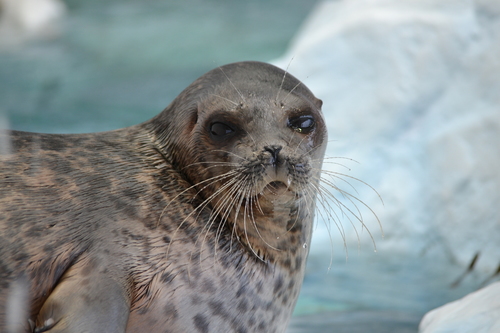
Ringed Seal
Pusa hispida
The ultimate survivor of the high Arctic, the Ringed Seal is a master of the ice. Known for its beautiful patterned coat and incredible ability to live beneath the frozen sea, it is the cornerstone of the northern ecosystem.
Quick Identification
Size
1.1 to 1.5 meters (3.6 to 5 feet) in length; 50 to 70 kg (110 to 150 lbs)
Colors
Light gray to silver coat with a dark back featuring distinctive light gray rings surrounding dark spots; pale, unspotted underside.
Key Features
- Small head with a short, cat-like snout
- Distinctive light-colored rings on a darker back
- Powerful, thick claws on front flippers for digging through ice
- Small, plump body shape that appears nearly round when hauled out
When You’ll See Them
Geographic range
Where Does the Ringed Seal Live?
The Ringed Seal is the most widely distributed seal in the northern hemisphere, claiming a truly circumpolar range. These resilient mammals are native to the Arctic Ocean and inhabit the coastal waters of the United States (Alaska), Canada, Russia, Greenland, and Norway. Beyond the high Arctic, specialized subspecies can also be found in the Baltic Sea and the freshwater environments of Lake Saimaa in Finland and Lake Ladoga in Russia, representing some of the most unique seal populations on Earth.
Basemap © OpenStreetMap contributors
Behavior
Ringed Seals are the most ice-dependent of all pinnipeds, spending the majority of their lives in close association with sea ice. They are famous for their ability to maintain breathing holes in ice up to two meters thick by using the heavy claws on their front flippers to scratch away at the frozen surface. During the winter, they often create 'subnivean' lairs—snow caves built over breathing holes—to protect themselves from freezing temperatures and predators like polar bears and arctic foxes.
These seals are generally solitary, though they may congregate in small groups near particularly good breathing leads or during the molting season. While they are naturally wary of humans and land-based threats, they spend a significant amount of time under the ice foraging for food. Their relationship with humans is primarily limited to indigenous subsistence hunting and scientific observation, as their remote habitat keeps them away from most urban centers.
EverydayEarth exclusive
Camera Tips
Capturing a Ringed Seal on camera requires specific focus on ice dynamics. If you are in a region where these seals haul out, position your camera near known breathing holes or 'leads' (cracks in the ice). Because the environment is overwhelmingly white, set your exposure compensation to +1 or +2 to prevent the snow from looking gray and the seal from appearing as a dark, featureless silhouette. Use a camera with a fast trigger speed, as seals can disappear into the water in a fraction of a second if they sense vibration.
Battery life is your greatest enemy in the Arctic cold. Use external power banks or high-quality lithium batteries, as standard alkaline batteries will fail almost instantly in sub-zero temperatures. To avoid 'white-out' photos at night, ensure your camera’s infrared flash is powerful enough to reach at least 15-20 meters, as seals rarely haul out right next to shore-based structures. Mounting the camera on a weighted tripod or a secure ice-screw is better than using traditional straps, which can become brittle and snap in extreme cold.
Consider using time-lapse mode alongside motion triggers. In the vast, open expanses of sea ice, the motion sensor may struggle to pick up a seal that is more than 10 meters away. A time-lapse photo taken every 5 to 10 minutes can help you track seal presence over a long period, even if they don't trigger the PIR sensor. If you are monitoring a lair, keep the camera well-camouflaged and scent-free, as Ringed Seals have a surprisingly keen sense of smell to detect predators.
Similar Species
Species that look similar or are commonly confused with Ringed Seal.
Harbor Seal
Larger with a longer 'dog-like' snout and mottled spots rather than distinct rings.
Spotted Seal
Very similar in size but lacks the light-colored rings, featuring only solid dark spots on a silver background.
Ribbon Seal
Instantly recognizable by four bold, wide white bands on a dark black or brown body.
Frequently Asked Questions
Record Ringed Seal at your habitat
Connect a camera to start building your own species record — AI identifies every visitor automatically.