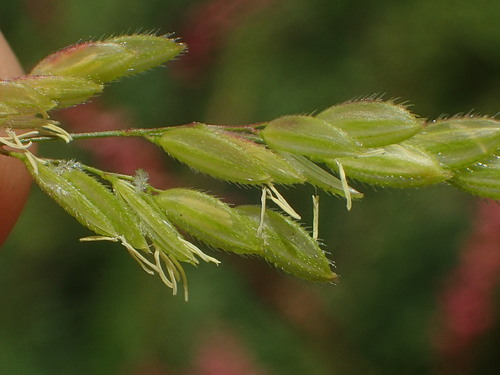
rice cutgrass
Leersia oryzoides
Armed with razor-sharp edges and a resilient spirit, rice cutgrass is a wetland powerhouse. This native grass provides essential cover for marsh-dwelling wildlife and a high-protein feast for visiting waterfowl.
Quick Identification
Size
Height 1–1.5 meters (3.3–5 feet); leaf blades up to 28 cm (11 inches) long
Colors
Bright lime green to pale yellow-green foliage; whitish-green flower panicles that turn straw-colored when dry
Key Features
- Microscopic silica teeth along leaf edges that can cause skin cuts
- Weak, sprawling stems that often lean on other vegetation
- Rough, sandpaper-like texture on all surfaces
- Open, wavy seed heads that often remain partially hidden in leaf sheaths
When You’ll See Them
Behavior
Rice cutgrass is a colony-forming perennial grass that thrives in saturated soils. It is famous for its "sticky" feel, caused by thousands of tiny, recurved teeth that act like a natural Velcro, allowing the plant to scramble over neighboring vegetation for support. Because its stems are relatively weak and hollow, it rarely stands perfectly upright, instead forming dense, tangled mats that create a protective canopy for small wetland creatures.
One of its most unique biological traits is its dual-flowering strategy. While it produces visible, airy seed heads (panicles) at the top of the plant to catch the wind, it also produces "cleistogamous" flowers hidden within the leaf sheaths. These internal flowers self-pollinate without ever opening, ensuring the plant can produce seeds even during years with poor weather or low pollinator activity. This makes it an incredibly reliable food source for local wildlife.
EverydayEarth exclusive
Camera Tips
Capturing rice cutgrass on camera is best approached as a study in texture and wildlife interaction. Because this grass is a magnet for waterfowl, marsh birds, and small mammals, position your camera at a low "frog’s-eye" level (roughly 6 to 12 inches off the ground) near the edge of a water feature where the grass is densest. This low angle allows you to see the intricate structure of the seed heads against the sky and captures the many creatures that use the grass mats for cover.
For those using AI-powered cameras, set your device to "Time Lapse" mode during the late summer months. This is the best way to document the plant's unique growth habit as it sprawlingly overtakes its neighbors. If your camera has a macro lens or high-resolution sensor, try to aim it at the leaf margins during the early morning. The dew often clings to the tiny silica teeth, creating a shimmering, jeweled effect that is visually stunning and highlights the plant's namesake feature.
Look for "tunnels" or flattened paths through the grass. Muskrats, voles, and marsh rabbits frequently create highways through rice cutgrass stands. Placing a trail camera at the entrance of these natural tunnels will yield excellent footage of wildlife behavior. Be mindful of the camera's infrared (IR) settings at night; the high silica content and the pale color of the dried grass can be highly reflective, sometimes causing "white-out" images. To prevent this, angle the camera slightly downward or place it at a distance of at least 5 feet from the nearest grass blades.
Finally, keep an eye on the weather forecast. Rice cutgrass is particularly beautiful when filmed during a light breeze or immediately after a rainstorm. The way the weak stems sway and the heavy seed heads bounce provides a sense of movement that static photos can't capture. Use a high frame rate (60fps) if available to catch the fast-moving birds that frequently dive into the grass to feast on the energy-rich seeds.
Similar Species
Species that look similar or are commonly confused with rice cutgrass.
Frequently Asked Questions
Record rice cutgrass at your habitat
Connect a camera to start building your own species record — AI identifies every visitor automatically.