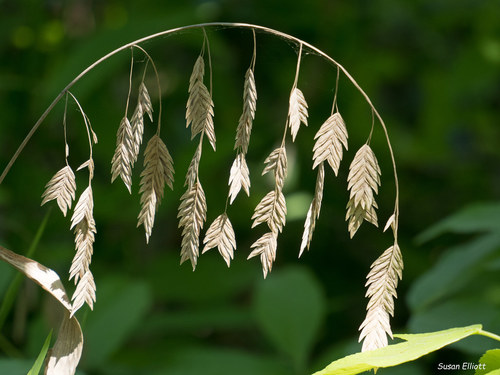
river oats
Chasmanthium latifolium
A graceful woodland native known for its unique 'fish-like' seed heads that dance in the breeze. River oats bring year-round texture and vital habitat to shady backyard corners and stream banks.
Quick Identification
Size
2-4 feet (0.6-1.2 m) tall with a 1-2 foot (30-60 cm) spread
Colors
Bright green foliage in summer; seed heads transition from lime green to tan and bronze-copper in autumn.
Key Features
- Flat, drooping seed heads resembling small fish or oat spikelets
- Wide, bamboo-like leaf blades up to 1 inch across
- Arching stems that sway easily in the breeze
- Clump-forming growth habit that turns golden-brown in winter
When You’ll See Them
Behavior
River oats are resilient perennial bunchgrasses that bring a unique architectural element to the landscape. Unlike many ornamental grasses that require full sun to thrive, river oats are specifically adapted to the dappled light of forest understories and the moist soil of riverbanks. They are clumping plants that spread slowly through a combination of short rhizomes and self-seeding, making them an excellent choice for stabilizing soil in shady, erosion-prone areas.
As a key player in the local ecosystem, river oats provide more than just aesthetic beauty. During the growing season, they serve as a host plant for several species of butterflies, while their dense foliage offers protective cover for small mammals and ground-nesting birds. The plant is most famous for its persistent seed heads, which remain on the stalks throughout the winter, providing a critical late-season food source when other forage is scarce.
EverydayEarth exclusive
Camera Tips
Capturing the beauty of river oats on a backyard camera requires a focus on movement and lighting. Because this grass is known for its drooping, heavy seed heads, position your camera at a relatively low angle—about 18 to 24 inches off the ground—pointing slightly upward. This 'worm's eye view' emphasizes the unique 'fish-on-a-fishing-pole' structure against the sky or forest canopy. To capture the best detail, ensure the camera is placed in a spot that receives backlit morning or late-afternoon sun; the low sun will illuminate the flat seed heads, making them appear to glow in gold or copper tones.
Since river oats are a magnet for specific wildlife, use your camera's 'Time-Lapse' or 'Video' mode rather than just still photos. Small granivorous birds like sparrows and finches, as well as small mammals, often visit to feast on the seeds. By setting the camera to record 15-30 second clips triggered by motion, you are likely to catch the dramatic swaying of the stalks as a bird lands on them. If you are interested in entomology, use a camera with a short focal distance to capture the Pepper and Salt Skipper caterpillars that use the leaves as their primary food source.
Wind is your best friend for dynamic shots but can cause motion blur in low light. To get crisp images of the grass 'dancing,' ensure the camera is placed in a spot that gets at least a few hours of bright, filtered light. In the winter, river oats stand out beautifully against a backdrop of snow. If you live in a snowy climate, leave the stalks standing and clear a small patch of snow directly in front of the plant; this often encourages ground-foraging birds to linger in the frame while they search for fallen seeds.
Finally, consider the seasonal transition for a long-term camera project. Place your camera in late summer (August) when the seed heads are fully formed but still vibrant green, and keep it in the same position through the first hard frost. The transition from lush green to deep, metallic bronze is one of the most striking visual transformations in the backyard. Avoid placing the camera in deep, dark shade where the sensor might struggle with graininess; a spot with 'dappled' light provides the most natural and vibrant results for this species.
Similar Species
Species that look similar or are commonly confused with river oats.
Frequently Asked Questions
Record river oats at your habitat
Connect a camera to start building your own species record — AI identifies every visitor automatically.