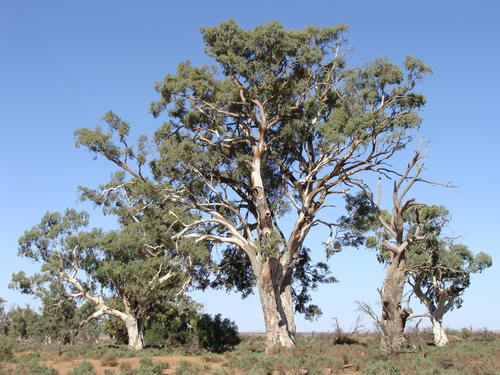
River Red Gum
Eucalyptus camaldulensis
The stoic sentinel of the Australian outback, the River Red Gum is more than just a tree—it is a sprawling, living ecosystem that defines the riverine landscape.
Quick Identification
Size
A large tree typically reaching 20–45 metres (65–148 feet) in height, with a massive trunk girth often exceeding 2 metres (6.5 feet).
Colors
Mottled bark with patches of white, cream, pink, and charcoal grey; dull green to blue-green lance-shaped leaves; creamy white flowers.
Key Features
- Smooth mottled bark that sheds in irregular patches
- Lance-shaped adult leaves with a distinct eucalyptus scent
- Hemispherical woody seed capsules with valves extending beyond the rim
- Large, spreading canopy that often overhangs watercourses
When You’ll See Them
Geographic range
Where Does the River Red Gum Live?
The River Red Gum is the most widely distributed eucalyptus species in Australia, found across almost the entire mainland. It is most iconic within the Murray-Darling Basin and along the ephemeral creeks of the arid interior, where its presence signals the location of underground water. While native to Australia, it has been successfully introduced to Mediterranean and semi-arid climates globally, including parts of California, South Africa, and Israel.
Basemap © OpenStreetMap contributors
Behavior
The River Red Gum is a cornerstone of the Australian ecosystem, known for its incredible longevity and its specialized relationship with water. It is famously a 'self-pruning' tree; during times of severe drought or heat stress, it may unexpectedly drop large, heavy limbs to conserve moisture and ensure the survival of the main trunk. This behavior has earned it the colloquial name 'Widow Maker' among bush campers, but it serves a vital ecological purpose by creating large woody debris on the forest floor, which provides habitat for ground-dwelling reptiles and insects.
Ecologically, these trees are the primary 'apartment blocks' of the Australian bush. As they age—often living for several centuries—they develop large hollows that provide essential nesting and roosting sites for hundreds of species, including cockatoos, parrots, owls, and gliders. They are also highly adapted to flooding; their seeds are often dispersed by rising river levels, germinating in the nutrient-rich silt left behind as waters recede.
EverydayEarth exclusive
Camera Tips
When photographing a River Red Gum with a trail camera, focus on its role as a wildlife hub. The best placement is not actually on the tree itself, but facing it from a distance of 10-15 feet. This allows you to capture the full architectural beauty of its twisted limbs and mottled bark. If you are looking to capture the birds and mammals that call the tree home, aim your camera at a known hollow or a low-hanging branch. Because these trees are often near water, ensure your camera is secured at a height that can withstand seasonal flooding.
Lighting is your best friend when capturing this species. Use a time-lapse setting during the 'golden hours' of dawn and dusk. The low-angled sun highlights the dramatic textures and colors of the peeling bark, which can range from vivid orange to cool grey. If your camera is equipped with high-resolution sensors, the fine detail of the bark's texture makes for stunning, high-contrast imagery that stands out in any digital collection.
For backyard users, mounting a camera on a sturdy River Red Gum limb can provide a unique 'bird's eye view' of your yard. However, be mindful of the tree's growth; use elasticated straps rather than nails or screws to avoid damaging the cambium layer. During the flowering season (typically December to February), position your camera near the outer canopy to record the frantic activity of honeyeaters and rainbow lorikeets drawn to the nectar-rich white blossoms.
Similar Species
Species that look similar or are commonly confused with River Red Gum.
Frequently Asked Questions
Record River Red Gum at your habitat
Connect a camera to start building your own species record — AI identifies every visitor automatically.