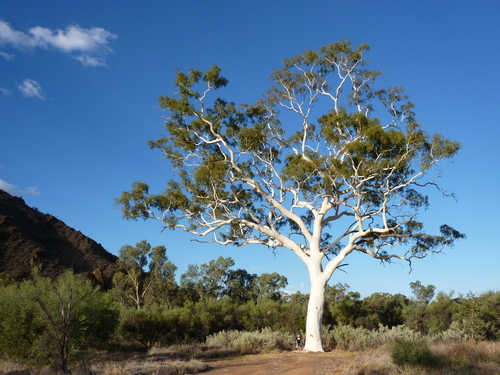
Ghost Gum
Corymbia aparrerinja
An iconic symbol of the Australian desert, the Ghost Gum is famous for its hauntingly beautiful white bark and its ability to provide life-saving shelter in the arid Outback.
Quick Identification
Size
Height 15-20 metres (50-65 feet); trunk diameter up to 1 metre (3.3 feet)
Colors
Brilliant bone-white to creamy-grey bark; dull grey-green foliage
Key Features
- Smooth, powdery white bark that persists year-round
- Lance-shaped or curved leaves with a drooping habit
- Small white to cream-colored flowers in clusters of 3 or 7
- Thin-walled, cup-shaped woody fruit known as gumnuts
When You’ll See Them
Geographic range
Where Does the Ghost Gum Live?
The Ghost Gum is a quintessential inhabitant of the Australian interior. It is native to the vast, arid landscapes of Central Australia, with its core populations concentrated throughout the Northern Territory, particularly around the MacDonnell Ranges. Its range also extends into the dry rocky outcrops of Western Australia and the western plains of Queensland, making it a definitive feature of the 'Red Centre.'
Basemap © OpenStreetMap contributors
Behavior
The Ghost Gum is a resilient icon of the Australian Outback, known for its striking white appearance and ability to thrive in harsh, arid conditions. Unlike many other eucalypts that have rough or stringy bark, the Ghost Gum’s bark is incredibly smooth and sheds in thin, papery scales, leaving behind a fine white dust. This light-colored bark is thought to reflect intense desert sunlight, keeping the tree cooler during the extreme heat of the day.
Ecologically, the tree acts as a vital 'apartment complex' for desert fauna. Older trees frequently develop hollows, which provide essential nesting sites for pink cockatoos, budgerigars, and various species of owls. While it appears serene, the Ghost Gum is known for 'self-pruning'—dropping large, heavy limbs without warning during periods of drought to conserve moisture, a behavior that has earned it a reputation for being slightly unpredictable in a backyard or park setting.
EverydayEarth exclusive
Camera Tips
When photographing or monitoring a Ghost Gum with a trail camera, the primary challenge is the bark's high reflectivity. Because the trunk is brilliant white, standard infrared flashes can 'white-out' the image at night. To combat this, set your camera to 'Low Glow' or 'No Glow' mode, and if possible, manually reduce the flash intensity. Positioning the camera at a slight angle to the trunk rather than directly head-on will also help reduce glare.
Ghost Gums are hotspots for bird activity. To capture the best footage, aim your camera at a height of 2-3 metres (6-10 feet) toward a large, horizontal limb or a known hollow. These trees are frequently visited by parrots and honeyeaters during the flowering season. If you are monitoring the base of the tree, look for 'lizard runs' near the roots; many desert monitors and skinks use the crevices in the base for shelter.
If you are setting up a camera in a backyard setting to observe visitors, place it approximately 3 to 5 metres away from the main trunk to capture the full silhouette of the tree against the sky. This is particularly effective at sunset or sunrise when the white bark takes on a golden or pinkish glow. Time-lapse mode is an excellent setting for this species to capture the movement of the sun across its striking white limbs over the course of a day.
Similar Species
Species that look similar or are commonly confused with Ghost Gum.
Frequently Asked Questions
Record Ghost Gum at your habitat
Connect a camera to start building your own species record — AI identifies every visitor automatically.