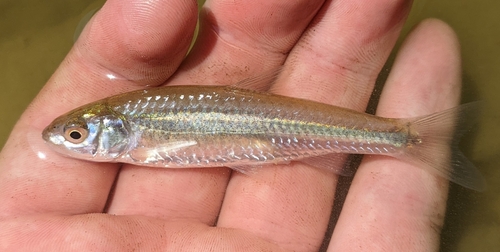
River Shiner
Alburnops blennius
A shimmering master of the current, the River Shiner is a vital part of North America's great river systems. Often seen in large, glittering schools, this resilient minnow is the unsung hero of the freshwater food web.
Quick Identification
Size
5 to 13 cm (2 to 5 inches) in length; 2 to 10 grams (0.07 to 0.35 ounces)
Colors
Silvery-white sides with a pale olive to yellowish back; translucent fins and a faint dark stripe along the midline of the back
Key Features
- Blunt, rounded snout extending slightly over the mouth
- Large, prominent eyes relative to head size
- Deep, compressed body shape compared to other shiners
- Diamond-shaped scales outlined in dark pigment
When You’ll See Them
Geographic range
Where Does the River Shiner Live?
Native to the vast heartland of North America, the River Shiner thrives across the central United States and southern Canada. Its range is anchored by the massive Mississippi River basin, stretching from the eastern edge of West Virginia to the high plains of Colorado, and extending north into the Hudson Bay basin through Manitoba and Alberta. This species is a true specialist of the continent's great interior waterways, found in abundance from the cold northern reaches of the Red River down to the warm, winding deltas of Texas and Louisiana.
Basemap © OpenStreetMap contributors
Behavior
The River Shiner is a highly social and energetic fish that spends its life navigating the currents of large river systems. They are typically found in large schools, a behavior that provides protection from predators and increases foraging efficiency. These fish are well-adapted to the moving water, often hovering just above the riverbed in the lee of sandbars or submerged structures where the current is slightly slower.
While they are sensitive to significant pollution, they are remarkably tolerant of turbidity, meaning they can thrive in the silty or muddy waters common in the Mississippi and Missouri River basins. They do not interact directly with humans, but they are an essential link in the ecosystem, converting small invertebrates into energy that sustains larger game fish like walleye and smallmouth bass.
EverydayEarth exclusive
Camera Tips
Capturing the River Shiner requires an underwater approach, as these fish rarely surface. The most effective method is using a waterproof action camera or an AI-enabled camera inside a high-quality underwater housing. Seek out 'transition zones' in the river—areas where a fast current meets a slower pool or the edge of a sandbar. These are natural gathering spots for shiners looking for food to be delivered by the current.
Position your camera at a low angle, roughly 3 to 5 inches above the sandy bottom, facing slightly upstream or across the current. This allows you to capture the fish in profile as they school together. Because river water can be turbid, try to film on bright, sunny days between 10 AM and 2 PM when the sun is directly overhead; this provides the best light penetration through the water column and makes their silver scales 'pop' against the background.
If you are struggling to get them to stay in the frame, you can use a small mesh bait bag filled with crushed insects or high-protein fish meal. Secure the bag to a heavy rock just upstream of your camera's field of view. The scent trail will encourage the school to linger and forage in front of the lens. Always ensure your camera is securely weighted or tethered, as even moderate river currents can easily shift or sweep away lightweight equipment.
Similar Species
Species that look similar or are commonly confused with River Shiner.
Frequently Asked Questions
Record River Shiner at your habitat
Connect a camera to start building your own species record — AI identifies every visitor automatically.