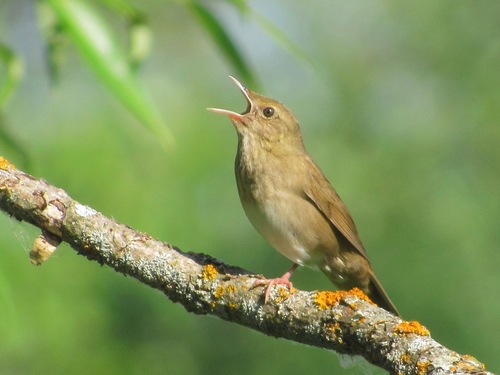
River Warbler
Locustella fluviatilis
A master of disguise, the River Warbler is a secretive traveler that connects the riverbanks of Eastern Europe to the wilds of Southern Africa. Known for its mechanical, machine-like song and mouse-like movements, it is a rewarding challenge for any backyard wildlife enthusiast.
Quick Identification
Size
Length: 14.5–16 cm (5.7–6.3 in); Wingspan: 21–24 cm (8.3–9.4 in); Weight: 16–22 g (0.56–0.78 oz)
Colors
Uniform dark olive-brown upperparts; pale grey-white underparts with blurry, dark olive streaking on the throat and breast; buff-colored undertail coverts with white tips.
Key Features
- Distinctive blurry streaks on the throat and upper breast
- Broad, rounded tail with long undertail coverts
- Olive-brown plumage without distinct wing bars
- Mouse-like creeping behavior through dense undergrowth
When You’ll See Them
Geographic range
Where Does the River Warbler Live?
Native to the Palearctic region, the River Warbler is a quintessential summer resident of Central and Eastern Europe, with its breeding range extending from eastern Germany through Poland and Russia into Western Siberia. This long-distance migrant undertakes a massive annual journey, crossing the equator to winter in the lush, inland landscapes of Southern Africa. Its wintering grounds are centered around the Zambezi River basin, stretching through Zimbabwe and Botswana to the outskirts of Pretoria in South Africa.
Basemap © OpenStreetMap contributors
Behavior
The River Warbler is one of the most elusive songbirds in the Palearctic, known more for its mechanical, insect-like song than its appearance. It is famously secretive, preferring to spend its time deep within tangled vegetation, nettles, or damp thickets. Instead of hopping like many other small birds, it often walks or runs along the ground with a rhythmic, mouse-like gait, making it exceptionally difficult to spot without the aid of a camera.
During the breeding season, males are most vocal at dawn and dusk, though they are known to sing throughout the night. Their song is a relentless, monotonous reeling that can last for several minutes without a break. While they are generally solitary and territorial during the summer, they remain quiet and unassuming during their long migration to Southern Africa, where they lead an equally cryptic lifestyle in tropical scrub and reedbeds.
EverydayEarth exclusive
Camera Tips
Capturing a River Warbler on camera requires patience and strategic placement because these birds rarely fly into the open. Position your camera very low to the ground—no more than 30 to 50 centimeters high—near the edge of dense, damp vegetation or a slow-moving stream. Because they prefer to 'walk' through the undergrowth, a camera angled along a clear path through tall grass or nettles is your best bet for a clear shot.
While traditional bird feeders won't attract this insect-eater, a shallow ground-level water feature or a dripping birdbath can be an irresistible lure. They are particularly attracted to damp mud and leaf litter where they forage for insects. Set your camera to a high-sensitivity motion trigger with a fast shutter speed; these birds move with a quick, nervous energy that can easily result in motion blur in low-light conditions.
The best time to capture activity is during the early morning hours when the males are most active near their singing perches. In the breeding season, look for a perch that sits slightly higher than the surrounding weeds—this is where a male might briefly emerge to sing. Use a burst mode setting (3-5 photos per trigger) to increase your chances of getting a profile shot as the bird moves through the frame.
Similar Species
Species that look similar or are commonly confused with River Warbler.
Savi's Warbler
Lacks the streaked breast of the River Warbler and has a more uniform, reddish-brown back.
Common Grasshopper Warbler
Smaller with distinct dark spots/streaks on its back, whereas the River Warbler has a plain, unspotted back.
Garden Warbler
Lacks any streaking on the breast and has a much shorter, stubbier bill compared to the River Warbler.
Frequently Asked Questions
Record River Warbler at your habitat
Connect a camera to start building your own species record — AI identifies every visitor automatically.