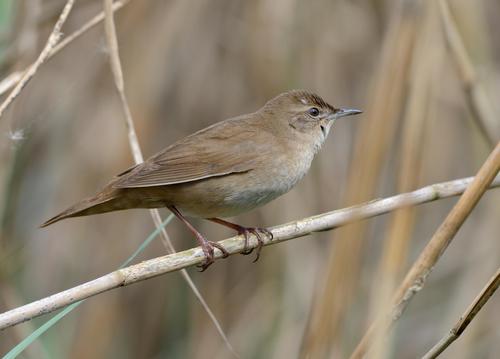
Savi's Warbler
Locustella luscinioides
A master of disguise within the reeds, Savi's Warbler is famous for its mechanical, grasshopper-like song. Discover how to spot this secretive wetland dweller with our expert guide.
Quick Identification
Size
Length 14–15 cm (5.5–6 in), wingspan 19–23 cm (7.5–9 in), weight 14–22 g (0.5–0.8 oz)
Colors
Uniform warm reddish-brown upperparts, buffy-white throat and belly, with unstreaked plumage and pale undertail coverts
Key Features
- Broad, rounded tail with long undertail coverts
- Uniform, unstreaked reddish-brown back
- Mechanical, reeling song like a high-pitched cricket
- Pale buff eyebrow (supercilium) is faint but present
When You’ll See Them
Behavior
Savi's Warblers are the ghosts of the reed beds. They are notoriously secretive birds that spend most of their time "skulking" deep within dense vegetation. Unlike many other warblers that flit actively in the open, Savi's prefers to move through the reeds like a mouse, rarely showing itself except when the male climbs a reed stem to sing. Their social life is largely solitary during the breeding season, though they are highly territorial over their chosen patch of marshland.
When it comes to human interaction, they are exceptionally shy. You are far more likely to hear their distinctive "reeling" song—which sounds remarkably like a high-pitched mechanical buzzing or a cicada—than you are to see one. They don't typically visit garden feeders, as they are strict insectivores that rely on the specific micro-ecosystem of a healthy wetland to survive.
EverydayEarth exclusive
Camera Tips
Capturing a Savi's Warbler on camera requires patience and specific placement because they rarely leave the dense cover of reeds. If you have a property bordering a wetland or a large pond with reed fringes, place your AI-powered camera on a sturdy stake or reed bundle about 3 to 4 feet above the water level. Aim the lens toward small "windows" or natural clearings within the reeds where the birds might pause while foraging or moving between territories.
Because these birds are insect-hunters rather than seed-eaters, traditional bird feeders won't attract them. Instead, focus your efforts on song-perches. During the breeding season (late spring and early summer), males consistently return to the same tall, exposed reed stems to deliver their mechanical reeling song. Look for these "singing posts" and position your camera at a slight upward angle to capture the bird against the sky or distant foliage, which helps the AI differentiate the brown bird from the brown reeds.
Lighting is crucial in dense marsh habitats. Set your camera to trigger with high sensitivity, as Savi's Warblers move quickly and discretely. Early morning (just before sunrise) and late evening are the best times, as this is when the males are most vocal and likely to be perched prominently. Use a fast shutter speed setting if available to avoid motion blur, as their throat feathers vibrate rapidly while singing.
In terms of lures, sound can be more effective than food. While we recommend observing naturally, the presence of a healthy, insect-rich environment is the best long-term draw. Ensure your camera is protected with a waterproof housing, as the humid, damp environment of a reed bed can lead to lens fogging or moisture damage. Checking the lens for condensation during the early morning hours will ensure your captures remain crisp and clear.
Similar Species
Species that look similar or are commonly confused with Savi's Warbler.
Frequently Asked Questions
Record Savi's Warbler at your habitat
Connect a camera to start building your own species record — AI identifies every visitor automatically.