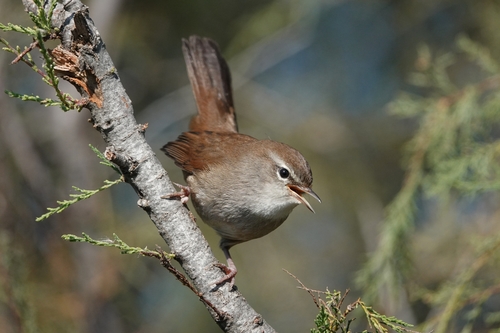
Cetti's Warbler
Cettia cetti
The Cetti’s Warbler is the 'phantom' of the reed beds, known for its sudden, explosive song and secretive nature. While difficult to spot with the naked eye, this hardy resident is a rewarding find for patient backyard observers with the right camera setup.
Quick Identification
Size
13–14 cm (5.1–5.5 in) long; 15–19 cm (6–7.5 in) wingspan; weight 12–18 g (0.4–0.6 oz)
Colors
Rich chestnut-brown or rufous upperparts; pale grayish-white underparts; faint whitish eyebrow (supercilium); dark brown eyes and pinkish-brown legs.
Key Features
- Explosive, loud, rhythmic song
- Short, rounded wings and a broad, rounded tail
- Skulking behavior in dense, damp vegetation
- Rich reddish-brown back contrasting with a pale grey throat
When You’ll See Them
Geographic range
Where Does the Cetti's Warbler Live?
Native to the temperate regions of the Old World, the Cetti’s Warbler primarily inhabits southern and western Europe, extending its reach across North Africa and through the Middle East into Central Asia as far as Afghanistan. In recent decades, it has significantly expanded its range northward into the United Kingdom and northern France as winters have become milder. It is a true resident of its chosen landscape, rarely venturing far from its home thicket unless pushed by extreme cold or habitat loss.
Basemap © OpenStreetMap contributors
Behavior
Though solitary by nature, males are fiercely territorial, using their powerful voices to mark their boundaries. They are not highly migratory, often staying in their territory year-round if the winters are mild. Because they live in such dense environments, they have developed a nervous, flicking movement of the wings and tail when agitated or moving through twigs. They are rarely seen flying across open spaces, preferring to 'creep' through the undergrowth like a mouse.
EverydayEarth exclusive
Camera Tips
Capturing a Cetti’s Warbler on camera is a badge of honor for any backyard wildlife enthusiast. Because these birds rarely fly into the open, your camera placement is the most critical factor. Position your AI camera low to the ground—no more than 1 to 2 feet high—facing a small clearing or a 'pathway' through dense, damp scrub or reed edges. If you have a garden pond with overhanging vegetation, this is the gold standard for placement, as they frequently visit water margins to forage for insects.
Since these birds are famously 'skulking,' they are unlikely to visit a traditional bird feeder perched on a pole. Instead, focus on natural lures. A slow-dripping water feature or a small, shallow bird bath placed very near thick cover will often entice them out of the shadows for a quick drink or bath. Ensure the camera is set to its highest sensitivity and fastest trigger speed; Cetti's Warblers move with quick, jerky motions and rarely stay still for more than a second or two.
Lighting can be a challenge in the dense, shaded areas these birds love. Try to angle your camera to take advantage of 'golden hour' light—early morning or late afternoon—when the sun might penetrate the lower layers of the scrub. If your camera supports audio triggers, the explosive song of the Cetti’s Warbler is the perfect cue. Listen for that unmistakable 'chewee-chewee-chewee' to know when they are nearby, and consider checking your footage immediately after a vocal outburst.
Similar Species
Species that look similar or are commonly confused with Cetti's Warbler.
Eurasian Wren
Smaller with a shorter, cocked tail and fine dark bars on the wings; the Cetti's has a broader tail and more uniform chestnut coloring.
Common Nightingale
Larger with a more prominent eye and a different song structure; Nightingales are also migratory and prefer slightly different woodland scrub.
Frequently Asked Questions
Record Cetti's Warbler at your habitat
Connect a camera to start building your own species record — AI identifies every visitor automatically.