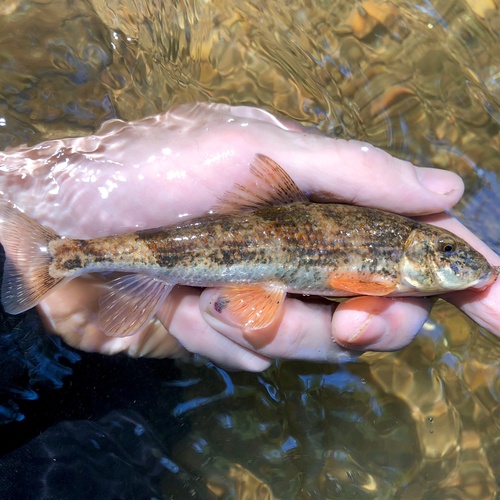
Roanoke Hog Sucker
Hypentelium roanokense
Meet the 'vacuum cleaner' of the Roanoke River—a rare and fascinating fish that thrives in the fastest currents. With its unique concave head and specialized feeding habits, the Roanoke Hog Sucker is a prized find for any backyard river explorer.
Quick Identification
Size
3 to 6 inches (7.6 to 15.2 cm) in length; typically weighs less than 0.5 lbs (0.2 kg).
Colors
Mottled olive and brown upper body with 4 distinct dark saddles across the back; pale cream to white belly; faint horizontal stripes on the lower scales.
Key Features
- Strongly concave (indented) head between the eyes
- Large, fleshy papillose lips positioned on the underside of the head
- Four dark, slanted saddles across the dorsal area
- Tapered, cylindrical body shape suited for bottom-dwelling.
When You’ll See Them
Behavior
The Roanoke Hog Sucker is a specialized bottom-feeding fish that spends its life navigating the rocky 'riffles' of the Roanoke River basin. Unlike many fish that swim in the middle of the water column, this species is built to hug the substrate, using its pectoral fins to brace against the current. They are relatively sedentary but are highly efficient foragers, using their sensitive, fleshy lips to feel for aquatic insects hiding under gravel and cobble.
Because they are sensitive to siltation and pollution, their presence is a hallmark of a healthy, oxygenated stream. They are generally solitary but can be seen near other 'cleaner' species like darters. When startled, they use a quick, darting motion to vanish into the shadows of larger boulders, making them a challenge to spot without a stationary camera setup.
EverydayEarth exclusive
Camera Tips
To capture the Roanoke Hog Sucker, you will need a waterproof action camera or a specialized underwater housing. Unlike land animals, these fish are best captured in 'riffles'—the shallow, bubbly sections of a stream where the water moves quickly over rocks. Secure your camera to a flat 'anchor stone' using a heavy-duty rubber strap or a weighted tripod base. Position the camera just a few inches off the bottom, angled slightly upward to catch the light filtering through the surface while keeping the rocky substrate in the lower third of the frame.
Timing is everything for underwater photography. The best footage is usually captured on bright, sunny days when the sun is directly overhead (midday). This allows light to penetrate the moving water, reducing the 'flicker' effect caused by surface ripples and highlighting the subtle olive and brown patterns of the fish. Avoid placing the camera in murky water or immediately after heavy rain, as the Roanoke Hog Sucker prefers clear conditions and will often hide when the water becomes turbid.
While you can't use traditional bait, you can encourage a visit by 'prepping' the area. Gently turn over a few large stones just upstream of your camera's field of view about five minutes before you start recording. This releases a small 'drift' of aquatic larvae into the current, which acts as a natural lure for the suckers. Set your camera to a high frame rate—at least 60 frames per second—to ensure that their rapid, jerky feeding motions remain crisp and clear during playback.
Similar Species
Species that look similar or are commonly confused with Roanoke Hog Sucker.
Frequently Asked Questions
Record Roanoke Hog Sucker at your habitat
Connect a camera to start building your own species record — AI identifies every visitor automatically.