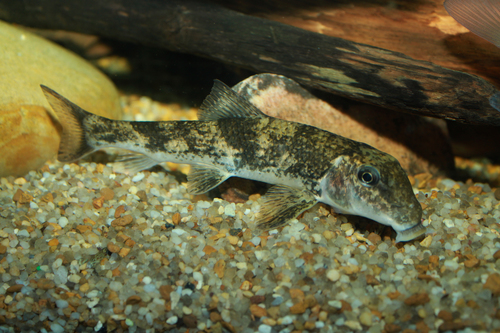
Northern Hog Sucker
Hypentelium nigricans
Meet the 'vacuum cleaner' of the riverbed. With its unique concave head and powerful suction-cup lips, the Northern Hog Sucker is a master of the fast-flowing stream.
Quick Identification
Size
8 to 15 inches (20 to 38 cm) long; typically weighs between 1 and 3 lbs (0.45 to 1.36 kg).
Colors
Mottled olive-brown or bronze upper body with 4 to 5 dark, oblique 'saddle' bands; white to pale yellow underside.
Key Features
- Concave or 'hollow' forehead between the eyes
- Large, fleshy suction-cup lips
- Four distinct dark diagonal bands across the back
- Broad, fan-like pectoral fins used for bracing against current
When You’ll See Them
Behavior
The Northern Hog Sucker is the industrious 'landscape architect' of the stream bed. Unlike many fish that swim mid-water, this species is almost always found in contact with the bottom, using its specialized snout to overturn stones and gravel. They are energetic foragers, moving with a series of jerky, hopping motions as they search for aquatic larvae. This behavior is so effective at dislodging food that other species, such as small darters and minnows, will often 'shadow' a feeding Hog Sucker to snatch up the debris it leaves behind.
These fish are generally solitary but will congregate in shallow, gravelly riffles during the late spring spawning season. They are highly sensitive to water quality and serve as excellent indicators of a healthy, oxygenated stream environment. While they are wary of overhead shadows, they are often surprisingly bold around underwater observers, focusing intently on their task of vacuuming the riverbed.
EverydayEarth exclusive
Camera Tips
Capturing high-quality footage of a Northern Hog Sucker requires an underwater setup or a very clear overhead view of a shallow riffle. For best results, place your waterproof AI camera in a 'run'—the area of a stream just below a fast-moving riffle where the water begins to smooth out but still moves quickly. Position the camera at a low angle, nearly level with the stream bed, to capture the unique way they use their fleshy lips to 'vacuum' the rocks. If you are filming from above the water, a polarized lens filter is absolutely essential to cut through the surface glare and reveal the fish's camouflaged patterns.
Because Hog Suckers are camouflaged to look like the shadows of rocks, they can be difficult for some AI motion sensors to trigger on. To improve your capture rate, set your camera to a higher sensitivity and ensure it is aimed at a patch of light-colored gravel or sand where the fish's dark 'saddle' markings will stand out in high contrast. These fish follow specific foraging paths, so if you see one in a particular spot, it is likely to return to that exact 'feeding station' later in the day.
Lighting is your best friend when filming underwater. Try to position your camera so the sun is behind it, illuminating the stream bed during the midday hours when the sun is highest. If the water is slightly murky, avoid using integrated camera lights, as they will reflect off suspended particles; instead, rely on natural light or external, off-axis lighting. During the spring spawning season in May and June, look for them in very shallow water (less than 6 inches deep), where you can often capture their most vigorous activity as they clear nests in the gravel.
Similar Species
Species that look similar or are commonly confused with Northern Hog Sucker.
White Sucker
Lacks the dark 'saddle' markings and has a rounded, rather than concave, forehead.
Alabama Hog Sucker
Very similar in appearance but is typically smaller and restricted to the Mobile River Basin.
Roanoke Hog Sucker
Has small orange or red spots on its scales and is only found in the Roanoke and Chowan river systems.
Frequently Asked Questions
Record Northern Hog Sucker at your habitat
Connect a camera to start building your own species record — AI identifies every visitor automatically.