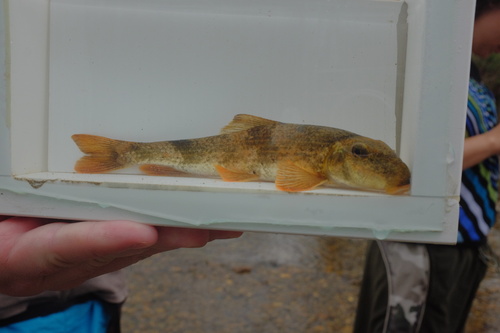
Alabama Hog Sucker
Hypentelium etowanum
A master of the riffles, the Alabama Hog Sucker uses its specialized 'vacuum' mouth to navigate the rocky currents of the American Southeast.
Quick Identification
Size
Typically 15-25 cm (6-10 inches) in length; weighs approximately 0.1-0.4 kg (0.2-0.9 lbs)
Colors
Mottled olive to bronze-brown upper body with four prominent dark dorsal saddles; belly is creamy white or yellowish; fins often show an orange or reddish tint.
Key Features
- Distinctly concave head between the eyes
- Four dark 'saddle' bands across the back
- Fleshy, downward-facing suction mouth
- Large, fan-like pectoral fins used for bracing against current
When You’ll See Them
Geographic range
Where Does the Alabama Hog Sucker Live?
Native to the North American continent, the Alabama Hog Sucker is a regional specialist of the Southeastern United States. Its core range is centered within the Mobile River basin, covering a significant portion of Alabama and extending into the Tennessee and Chattahoochee River drainages. This species is commonly found in the Appalachian foothills and Piedmont regions of Georgia, eastern Mississippi, and southern Tennessee, where it favors the clean, upland waters of the Gulf Slope.
Basemap © OpenStreetMap contributors
Behavior
The Alabama Hog Sucker is a highly specialized 'bottom-feeder' that thrives in the turbulent waters of rocky stream riffles. Unlike many fish that swim constantly, this species often rests on the stream bed, using its large, sturdy pectoral fins like kickstands to anchor itself against the rushing current. They are solitary foragers but can occasionally be found in small groups where food is abundant.
These fish are known for their unique 'rooting' behavior. They use their hardened snouts to flip over small rocks and gravel, creating a localized disturbance that flushes out hiding invertebrates. Because they are sensitive to siltation and water quality, their presence is often a good indicator of a healthy, oxygen-rich aquatic ecosystem. While generally shy, they are fascinating to observe as they methodically vacuum the substrate.
EverydayEarth exclusive
Camera Tips
To capture the Alabama Hog Sucker, you will need a waterproof action camera or a specialized underwater housing. Placement is critical: look for 'riffles,' which are shallow sections of the stream where the water ripples over rocks. Position your camera in the transition zone where the fast water begins to slow down into a deeper pool (the 'pool tail'). Secure the camera to a heavy flat rock using a mount or a weighted sandbag to ensure the current doesn't sweep it away.
Set your camera to a high frame rate, such as 60fps or 120fps. The Hog Sucker’s movements, especially when flipping rocks or darting between crevices, are incredibly fast; slow-motion playback will allow you to see their specialized feeding mechanics in detail. Aim the lens slightly upward from the bottom to capture the 'saddle' markings on their backs, which are their most distinctive feature from an aerial view but look striking from a side-profile underwater.
Lighting is your best friend when filming underwater. Try to set your camera during the middle of the day (10 AM to 2 PM) when the sun is directly overhead to penetrate the water column. If the water is slightly murky, place the camera closer to a 'feature' rock where you see algae growth, as Hog Suckers will likely visit that specific spot to forage. Avoid using artificial lights as they can cause heavy backscatter from suspended particles in the water.
Similar Species
Species that look similar or are commonly confused with Alabama Hog Sucker.
Frequently Asked Questions
Record Alabama Hog Sucker at your habitat
Connect a camera to start building your own species record — AI identifies every visitor automatically.