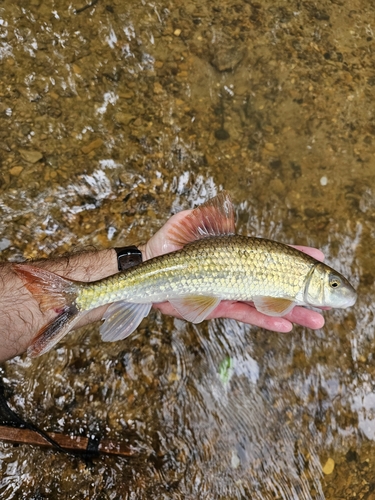
Blacktail Redhorse
Moxostoma poecilurum
The Blacktail Redhorse is a shimmering master of the southern riverbed, easily recognized by the bold black stripe on its tail. A key indicator of clean water, this striking fish brings a splash of gold and orange to clear freshwater streams.
Quick Identification
Size
Typically 25-41 cm (10-16 inches) in length, though some reach 51 cm (20 inches). Weight usually ranges from 0.4-1.1 kg (1-2.5 lbs).
Colors
Body is silvery-bronze to golden with a white belly. The most distinct feature is the caudal fin (tail), which has a sharp black horizontal stripe on the lower lobe, often bordered by orange or red.
Key Features
- Distinct black horizontal stripe on the lower half of the tail
- Fins often display a bright orange or reddish hue
- Large, diamond-shaped scales across a cylindrical body
- Inferior mouth with thick, fleshy lips for bottom-feeding
When You’ll See Them
Geographic range
Where Does the Blacktail Redhorse Live?
Native to the North American continent, the Blacktail Redhorse is primarily concentrated in the Gulf Slope drainages of the southern United States. Its territory extends from the Galveston Bay system in Texas across to the Choctawhatchee River in Florida, reaching northward into the Mississippi River tributaries as far as southern Kentucky. This species is a hallmark of the vibrant river systems throughout the former Mississippi Embayment and the Deep South.
Basemap © OpenStreetMap contributors
Behavior
The Blacktail Redhorse is a social and active member of the sucker family, often found schooling in small groups. They are bottom-dwellers by nature, using their specialized mouths to vacuum up food from the riverbed. Unlike many shy aquatic species, they are relatively active during daylight hours, especially in clear water where they can be seen moving gracefully over gravel bars and sandy flats.
During the spring, these fish undergo a significant behavioral shift as they migrate to shallow, fast-moving riffles to spawn. This is one of the few times they congregate in large numbers in very shallow water, making them more visible to observers. They are generally peaceful and do not exhibit territorial aggression, serving as an important link in the food chain by converting bottom-dwelling invertebrates into energy for larger predatory fish like Largemouth Bass.
EverydayEarth exclusive
Camera Tips
To capture the Blacktail Redhorse on camera, you will need an underwater setup or a very high-quality polarized lens for a shore-based trail cam. If you have a stream on your property, look for 'runs' or 'riffles'—areas where the water moves steadily over a gravel bottom. A waterproof action camera or a dedicated underwater scout camera should be mounted to a heavy base, like a weighted plate or a large flat rock, to prevent it from shifting in the current. Position the camera at a 45-degree angle to the flow of the water to minimize debris buildup on the lens.
Focus your efforts on the 'tail-outs' of pools, which are the shallower areas where water begins to speed up again before a riffle; Blacktail Redhorses often pause here to forage. Unlike mammals, you cannot easily bait these fish with food, but you can look for natural 'cleaning stations' or areas with fresh, overturned gravel where they have recently been feeding. Setting your camera to record in high-definition video (at least 60fps) is highly recommended, as their movements are fluid and the shimmering of their bronze scales is best captured in motion.
Lighting is the most critical factor for underwater photography in backyard creeks. Aim to have your camera active during the middle of the day (10 AM to 2 PM) when the sun is directly overhead, as this allows light to penetrate deepest into the water. In the spring months, move your camera to shallower water (6-12 inches deep) to catch the vibrant spawning runs, where the red and orange tints on their fins will be at their most brilliant. Be sure to wipe the lens clear of algae or silt every few days for the crispest images.
Similar Species
Species that look similar or are commonly confused with Blacktail Redhorse.
Golden Redhorse
Lacks the black stripe on the lower tail lobe and typically has more uniform golden-colored scales.
Silver Redhorse
Has a deeper body profile and silver fins, missing the orange/red tints and the black tail stripe.
Spotted Sucker
Features parallel rows of small dark spots along its sides rather than a single tail stripe.
Frequently Asked Questions
Record Blacktail Redhorse at your habitat
Connect a camera to start building your own species record — AI identifies every visitor automatically.