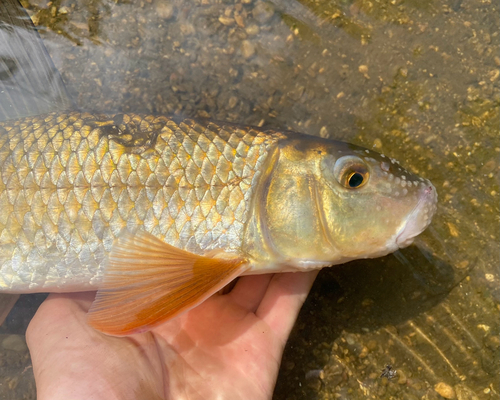
Golden Redhorse
Moxostoma erythrurum
A gleaming resident of North America's cleanest rivers, the Golden Redhorse is a master of the riverbed. With its brassy scales and gentle nature, it serves as a golden indicator of a healthy aquatic world.
Quick Identification
Size
Typically 12-18 inches (30-45 cm) in length and weighing 1-2 lbs (0.45-0.9 kg), though trophy specimens can reach 26 inches and 5 lbs.
Colors
Brassy or golden-olive sides with dark-edged scales, a white or cream-colored belly, and slate-gray to olive tail and dorsal fins.
Key Features
- Large, golden-to-bronze scales with dark bases
- Slate-gray tail fin (distinguishes it from the red-tailed Shorthead Redhorse)
- Subterminal mouth with thick, fleshy lips
- Solid, cylindrical body shape built for bottom-dwelling
When You’ll See Them
Geographic range
Where Does the Golden Redhorse Live?
Native to the freshwater systems of North America, the Golden Redhorse occupies a vast territory stretching from the Great Lakes and the Saint Lawrence River drainage in Canada down through the Mississippi River basin. Its core range encompasses the Midwestern and Southern United States, reaching as far west as Oklahoma and as far south as the Mobile Bay drainage in Alabama. It is an quintessential resident of the Ozarks and the Appalachian foothills, thriving in the well-oxygenated waters of these temperate regions.
Basemap © OpenStreetMap contributors
Behavior
The Golden Redhorse is a social, bottom-dwelling species that is often found in small schools, particularly during the juvenile stages. They are highly sensitive to water quality and siltation, acting as a biological indicator for the health of a river system. While they spend much of their time calmly hovering near the substrate, they are powerful swimmers capable of navigating moderate currents with ease.
During the spring, these fish exhibit fascinating spawning behavior, migrating into smaller, gravel-bottomed tributaries. Unlike many other fish, they do not build traditional nests; instead, they clear small areas of gravel through body movements. They are generally wary of humans but can become accustomed to observers in clear, slow-moving water, making them excellent subjects for patient underwater photography.
EverydayEarth exclusive
Camera Tips
Capturing the Golden Redhorse on camera requires an underwater setup, such as an action camera mounted on a weighted base or a specialized underwater trail camera. For the best AI recognition, place the camera in a run or riffle margin where the water is clear and between 2 to 4 feet deep. Position the lens horizontally, approximately 4-6 inches off the bottom, to capture the distinct scale patterns and mouth structure needed for identification.
To attract the Golden Redhorse to your camera's field of view, look for 'sucker holes'—areas of clean gravel among silty patches where they have been feeding. While they don't respond to traditional bait in the same way as catfish, you can stimulate their natural foraging behavior by gently disturbing the upstream substrate to release larvae and small invertebrates into the current. This 'chumming' with natural riverbed material often draws them in to investigate the drift.
Optimal lighting is key for capturing their metallic golden sheen. Aim to record during the mid-morning when the sun is high enough to penetrate the water column but not so direct that it creates heavy surface glare. If your camera supports it, use a high frame rate (60fps) to capture their subtle fin movements and the way they use their fleshy lips to sort through gravel. During the spring spawning run, focus your efforts on shallow gravel bars where activity is most concentrated.
Similar Species
Species that look similar or are commonly confused with Golden Redhorse.
Shorthead Redhorse
The Shorthead has a distinct bright red tail and a much smaller, narrower head compared to the Golden Redhorse.
Silver Redhorse
Larger and more silver-toned than golden, with a larger eye and a deeper body shape.
White Sucker
Has much smaller scales (over 55 along the lateral line) and a more slender, torpedo-like body shape.
Frequently Asked Questions
Record Golden Redhorse at your habitat
Connect a camera to start building your own species record — AI identifies every visitor automatically.