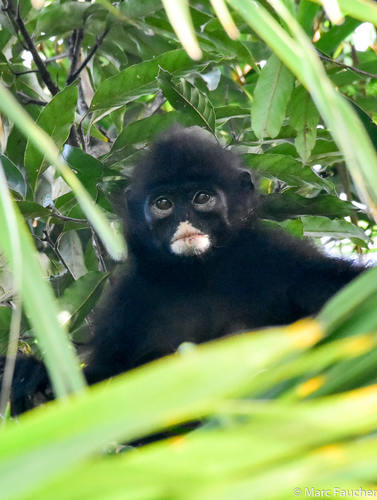
Robinson’s Banded Langur
Presbytis robinsoni
A graceful acrobat of the Southeast Asian canopy, Robinson’s Banded Langur is a striking primate known for its dark coat and shy demeanor. This leaf-eating specialist is a master of the high branches in the northern Malay Peninsula.
Quick Identification
Size
Head-body 43-61 cm (17-24 in); tail 60-85 cm (24-33 in); weight 5.5-8 kg (12-18 lbs)
Colors
Dark charcoal to chocolate-brown upperparts; distinct white or light greyish stripe on the belly and inner thighs; dark face with faint pale rings around the eyes.
Key Features
- Slender tail significantly longer than the body
- White or pale grey underparts and inner thighs
- Faint pale eye-rings on a dark face
- Diurnal and strictly arboreal build
When You’ll See Them
Geographic range
Where Does the Robinson’s Banded Langur Live?
This elusive primate is native to the northern regions of the Malay Peninsula in Southeast Asia. Its range extends from southern Myanmar, specifically the Tanintharyi Region, and travels through southern Thailand south of the Isthmus of Kra, reaching into the northern states of Peninsular Malaysia. While they are forest specialists, they are occasionally spotted near the edges of plantations or rural gardens that border protected jungle areas.
Basemap © OpenStreetMap contributors
Behavior
Robinson's Banded Langurs are primarily arboreal primates that spend the vast majority of their lives in the upper levels of the canopy. They are social creatures, typically living in small family units consisting of a single dominant male and several adult females with their offspring. Unlike some of the more boisterous macaques found in the same regions, these langurs are relatively shy and quiet, moving through the trees with remarkable agility and grace to avoid detection.
In terms of human interaction, they are generally elusive and tend to flee deeper into the forest when they sense movement or loud noises. They are most active during the cooler parts of the day, particularly in the early morning and late afternoon. During the midday heat, they often retreat to shaded branches to rest and digest their fibrous diet. Their social structure is stable, though younger males eventually leave their natal groups to form bachelor bands or attempt to lead their own harems.
EverydayEarth exclusive
Camera Tips
To capture high-quality footage of the Robinson's Banded Langur, elevation is your most critical factor. Since these monkeys are strictly arboreal and rarely descend to the ground, a camera mounted at eye-level will likely miss the action. Aim to place your camera 15 to 25 feet high using a sturdy ladder and safety harness. Look for "canopy bridges"—areas where the branches of neighboring trees overlap or touch—as these serve as the primary highways for langur travel.
Technical settings are vital for success. Set your camera to a high-speed trigger mode because langurs move with surprising speed when jumping between branches. A slow trigger will often result in "ghost" images or photos of just a tail. Video mode (1080p or 4K at 60fps) is highly recommended over still photos to capture the fluidity of their movement and social interactions. Because they are naturally wary, use a camera with "No-Glow" or "Black Flash" infrared technology; standard red-glow LEDs can startle them and cause the group to avoid that specific tree in the future.
If your backyard or trail camera site borders a forested area, identify local fruiting trees like wild figs (Ficus species) or Terminalia. These are natural magnets for the species. Avoid using artificial baits or food lures, which can disrupt their sensitive digestive systems and encourage unnatural behavior. Instead, position your camera to face north or south to avoid the harsh glare of the tropical sun, which can wash out the details of their dark fur and the subtle white markings on their bellies.
Similar Species
Species that look similar or are commonly confused with Robinson’s Banded Langur.
Frequently Asked Questions
Record Robinson’s Banded Langur at your habitat
Connect a camera to start building your own species record — AI identifies every visitor automatically.