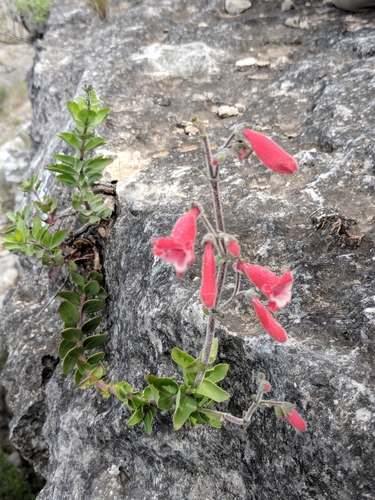
Rock Penstemon
Penstemon baccharifolius
The Rock Penstemon is a desert survivor that paints limestone cliffs with brilliant scarlet strokes. Its nectar-rich tubular flowers make it a premier destination for hummingbirds and butterflies during the heat of summer.
Quick Identification
Size
12-24 inches (30-60 cm) in height with a spread of 12-18 inches (30-45 cm)
Colors
Brilliant scarlet-red or cherry-red tubular flowers; dark green, leathery, serrated foliage
Key Features
- Brilliant scarlet-red tubular flowers with two-lipped openings
- Leathery, deeply serrated leaves resembling the Baccharis shrub
- Low-growing woody base with a mounding habit
- Bloom spikes reaching up to 2 feet in height
When You’ll See Them
Geographic range
Where Does the Rock Penstemon Live?
Native to the North American continent, the Rock Penstemon is a quintessential species of the Chihuahuan Desert and the Edwards Plateau. Its core range is found within the rugged Trans-Pecos region of Southwest Texas and extends south into the Mexican states of Coahuila and Chihuahua. While it is a specialist of limestone environments, it has been successfully introduced into water-wise suburban landscapes across the desert Southwest.
Basemap © OpenStreetMap contributors
Behavior
Rock Penstemon is a resilient perennial sub-shrub that thrives in the most punishing conditions of the American Southwest. Unlike many other penstemons that bloom in the spring and then go dormant, this species is a summer specialist, producing its vibrant red flower spikes during the hottest months from June through September. It has a slow-growing, woody habit that allows it to anchor firmly into limestone crevices and rocky slopes where few other plants can survive.
In the wild and in backyard gardens, this plant acts as a primary energy station for high-metabolism wildlife. Its tubular flowers are specifically evolved for hummingbird pollination, offering a rich nectar reward to those with long enough bills or tongues to reach the base of the bloom. It is a social plant in the ecological sense, frequently surrounded by a buzz of activity from Black-chinned Hummingbirds, large butterflies, and specialized long-tongued bees.
EverydayEarth exclusive
Camera Tips
To successfully capture the wildlife drawn to your Rock Penstemon, mount your camera on a sturdy stake or low tripod roughly 18 to 24 inches above the ground. You want the lens to be level with or slightly above the flowering spikes, as this is where hummingbirds will hover to feed. Position the camera about 3 to 5 feet away from the plant to ensure the AI can distinguish the small, fast-moving birds from the background foliage while maintaining a sharp focus on the scarlet blooms.
Because the primary visitors to Rock Penstemon are incredibly fast, your camera settings are crucial. Use a 'High Sensitivity' motion trigger and, if your camera allows, set it to take a burst of 3-5 photos or a short high-definition video clip. A fast shutter speed is essential for freezing the wing motion of hummingbirds; aim for at least 1/500th of a second. If you are using a trail camera, ensure the 'PIR' (Passive Infrared) sensor is unobstructed by waving leaves to avoid false triggers on windy days.
Lighting can make or break your shots of this species. Rock Penstemon thrives in full sun, which can cause harsh shadows or lens flare in the middle of the day. For the most vibrant reds and the best wildlife detail, orient your camera so the sun is behind it, illuminating the flowers directly during the early morning or late afternoon. These 'golden hours' coincide with the peak feeding times for hummingbirds and butterflies, providing both the best light and the most animal activity.
Lastly, consider the 'frame' of your shot. Rock Penstemon often grows in mounding clusters; choose the most upright and blossom-heavy spike as your primary focal point. Clear away any tall grasses or distracting weeds from the immediate foreground to give your AI camera a clear line of sight. If the plant is in a container, place it against a neutral-colored wall or a distant green hedge to help the brilliant red flowers and their visitors pop in the final image.
Similar Species
Species that look similar or are commonly confused with Rock Penstemon.
Frequently Asked Questions
Record Rock Penstemon at your habitat
Connect a camera to start building your own species record — AI identifies every visitor automatically.