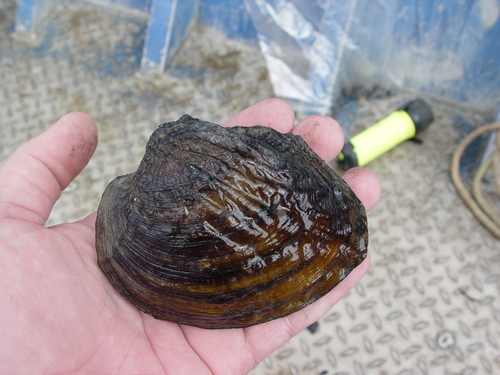
Rock-pocketbook
Arcidens confragosus
With a shell that looks like hand-carved stone, the Rock-pocketbook is a hidden architect of our river systems. This heavy-duty mussel acts as a natural water purifier, silently cleaning the Mississippi basin one gallon at a time.
Quick Identification
Size
Shell length typically ranges from 10 to 15 cm (4 to 6 inches); shells are notably thick and heavy.
Colors
Exterior is typically dark green, brown, or black; the inner shell (nacre) is usually white or iridescent pearl.
Key Features
- Large rhomboid-shaped shell that appears 'inflated'
- Distinctive zig-zag or 'W' shaped ridges across the shell surface
- Heavy, thick-walled shell compared to other river mussels
- Prominent beak sculpture consisting of several coarse loops
When You’ll See Them
Geographic range
Where Does the Rock-pocketbook Live?
Native to the North American continent, the Rock-pocketbook is a signature inhabitant of the vast Mississippi River drainage system. Its range is concentrated within the United States, extending from the Great Lakes region in the north, southward through the Ohio and Missouri River basins, and reaching down to the Gulf Coast drainages from Alabama to Texas. It is most frequently encountered in the deep, slow-moving silty channels of the central and southern U.S. waterways.
Basemap © OpenStreetMap contributors
Behavior
The Rock-pocketbook is a sedentary filter feeder that spends most of its life partially buried in the substrate of riverbeds. Unlike many more mobile wildlife species, its 'behavior' is largely defined by its interaction with the water column and its unique reproductive cycle. It plays a vital role in the ecosystem as a biological filter, cleaning the water by consuming microscopic particles and heavy metals, which are then sequestered in its shell or excreted as nutrient-rich waste for other organisms.
Its social interaction is primarily limited to its reproductive strategy, which involves a fascinating parasitic stage. Females release larvae, known as glochidia, which must attach to the gills or fins of specific host fish, such as the Gizzard Shad or Freshwater Drum. This 'hitchhiking' allows the mussels to disperse upstream and colonize new areas, a necessary feat for an animal that otherwise moves only a few inches in its lifetime.
EverydayEarth exclusive
Camera Tips
Capturing a Rock-pocketbook on camera requires a specialized approach since they are sub-aquatic. For backyard enthusiasts with creek or river access, an underwater action camera (like a GoPro) is essential. Use a weighted mount or a small tripod to stabilize the camera on the riverbed. Position the lens at a low angle, roughly 2-3 inches from the substrate, to capture the 'siphons'—the small openings where the mussel breathes and eats—protruding from the sand.
Good lighting is the biggest challenge underwater. If the water is murky, use a high-powered waterproof LED light angled from the side to create contrast and reveal the mussel's intricate shell ridges. Avoid direct front-lighting, as this often reflects off floating sediment, creating a 'snowstorm' effect in your footage. Setting your camera to a timelapse mode (one frame every 30 seconds) can beautifully illustrate the mussel slowly shifting in the mud or opening its shell to feed.
If you don't have underwater gear, you can still document this species by scouting riverbanks during periods of low water or drought. When water levels recede, 'spent' shells are often left on the banks. Use a macro lens or your smartphone’s portrait mode to capture the high-relief ridges that give the Rock-pocketbook its name. Early morning or late afternoon sun provides 'golden hour' side-lighting that emphasizes the texture of the shell better than midday sun.
Similar Species
Species that look similar or are commonly confused with Rock-pocketbook.
Frequently Asked Questions
Record Rock-pocketbook at your habitat
Connect a camera to start building your own species record — AI identifies every visitor automatically.