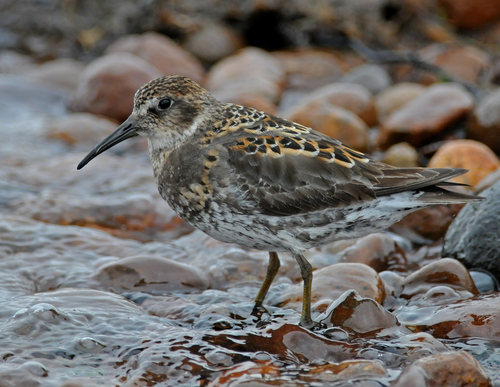
Rock Sandpiper
Calidris ptilocnemis
Meet the rugged adventurer of the Pacific coast. The Rock Sandpiper thrives where the waves are wildest, nimbly navigating icy surf and jagged shorelines that most birds avoid.
Quick Identification
Size
Length 20–25 cm (8–10 in), wingspan 37–42 cm (14.5–16.5 in), weight 60–110 g (2.1–3.9 oz)
Colors
Breeding adults have rufous-edged back feathers and a dark, mottled belly patch; winter plumage is a uniform slate-gray on the back and breast with white underparts.
Key Features
- Short, greenish-yellow or dull yellow legs
- Stocky, thick-set body with a slightly decurved bill
- Pale base on the lower mandible
- Breeding adults show a dark, messy patch on the lower breast
When You’ll See Them
Geographic range
Where Does the Rock Sandpiper Live?
Native to the North Pacific, the Rock Sandpiper is primarily found along the rugged coastlines of Alaska and the Russian Far East. These hardy birds frequent the islands of the Bering Sea and the Aleutian chain, with wintering populations stretching southward along the Pacific coast through British Columbia to California. It is the only shorebird that regularly winters as far north as the ice-free portions of the Bering Sea.
Basemap © OpenStreetMap contributors
Behavior
The Rock Sandpiper is one of the hardiest shorebirds in the Northern Hemisphere, often observed braving crashing waves and icy spray on rugged Pacific shorelines. Unlike many sandpipers that prefer soft mudflats, this species is a rock specialist, nimbly hopping between barnacle-encrusted stones and kelp beds to forage for food. They are remarkably well-camouflaged against dark volcanic rock and sea-slicked stones, often remaining invisible until they move.
During the breeding season, they migrate to the damp tundra of the Bering Sea islands and coastal Alaska. Here, males perform dramatic aerial displays, hovering and trilling to establish territories. They are known for being relatively tame around humans compared to other shorebirds, often allowing close approach before calmly walking—rather than flying—away from a perceived intruder.
EverydayEarth exclusive
Camera Tips
To capture the Rock Sandpiper on a trail camera, focus your efforts on the 'splash zone' of rocky shorelines or man-made jetties. Place your camera at a low height—about 12 to 18 inches off the ground—angled slightly upward to capture the bird's profile against the ocean. Because these birds are often found in areas with high moisture and salt spray, use a weatherproof housing and check the lens frequently for salt crusting, which can blur your shots.
Timing is critical for this species; set your camera to be most active during falling tides. As the tide recedes, it exposes fresh invertebrates on the rocks, which draws the sandpipers out to feed in specific, predictable spots. Using a high shutter speed or high-frame-rate video mode is recommended, as these birds move quickly to avoid incoming waves, and you’ll want to freeze that motion to see their yellow legs and bill details.
While traditional birdseed won't work, you can attract them to a camera site by choosing locations with heavy kelp accumulation (the wrack line). These areas are rich in kelp flies and small crustaceans that the sandpipers love. If you are on the breeding grounds in Alaska, placing a camera near damp, mossy hummocks in the tundra during June or July can yield spectacular footage of their nesting behavior.
Similar Species
Species that look similar or are commonly confused with Rock Sandpiper.
Purple Sandpiper
The Atlantic counterpart; virtually identical but geographically separated and slightly darker in winter.
Dunlin
Dunlins have a more dramatically drooping bill and their breeding belly patch is solid black rather than the Rock Sandpiper's mottled patch.
Sanderling
Much paler overall, almost white in winter, and strictly prefers sandy beaches over the Rock Sandpiper's preferred rocky habitat.
Frequently Asked Questions
Record Rock Sandpiper at your habitat
Connect a camera to start building your own species record — AI identifies every visitor automatically.