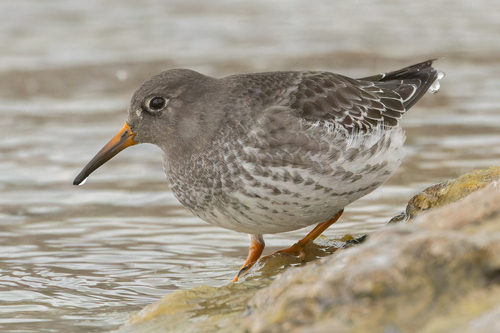
Purple Sandpiper
Calidris maritima
The ultimate winter warrior of the Atlantic coast, the Purple Sandpiper thrives where the waves are coldest and the rocks are most rugged. Discover how to spot this fearless 'mountaineer' of the shorebird world.
Quick Identification
Size
Length: 20-22 cm (7.9-8.7 in) | Wingspan: 42-46 cm (16.5-18.1 in) | Weight: 50-105 g (1.8-3.7 oz)
Colors
Winter birds are soot-grey with a subtle purple gloss on the back and white bellies; legs and the base of the bill are bright orange-yellow. Summer plumage is mottled brown and black.
Key Features
- Short, bright orange or yellow legs
- Slightly down-curved bill with a yellow-orange base
- Stocky, hunched silhouette
- Dark grey winter plumage with a faint purple sheen
When You’ll See Them
Geographic range
Where Does the Purple Sandpiper Live?
Native to the high Arctic and subarctic regions of the Northern Hemisphere, the Purple Sandpiper is a true winter specialist of the North Atlantic. Its core breeding grounds span the remote tundras of Canada, Greenland, Iceland, and Scandinavia, while its winter range extends down the Atlantic coast to the United States as far south as the Carolinas, and across Europe to the British Isles and the Baltic Sea. Unlike many other sandpipers that migrate to the Southern Hemisphere, this resilient bird stays as far north as open water permits, often wintering in the frigid environments of Newfoundland and coastal Norway.
Basemap © OpenStreetMap contributors
Behavior
The Purple Sandpiper is one of the hardiest shorebirds in the world, often found braving the icy spray of the North Atlantic while other species have long since flown south. They are specialized for life on rocky coastlines, where they can be seen scurrying over slippery, seaweed-covered rocks just inches away from crashing waves. Unlike many skittish shorebirds, they are remarkably tame and will often allow a close approach if you move slowly, earning them a reputation among birders as 'fearless' little waders.
During the winter, they are highly social and congregate in small, tight-knit flocks on breakwaters and jetties. Their foraging is dictated entirely by the tides; as the water recedes, they busily probe rock crevices for food, and as the tide rises, they hunker down together in sheltered nooks to roost. They are true masters of the 'intertidal zone,' showing incredible agility on wet, treacherous surfaces where most other animals would struggle to maintain their footing.
EverydayEarth exclusive
Camera Tips
Capturing the Purple Sandpiper requires a focus on coastal structures. If you have a backyard or property near a rocky shoreline or jetty, place your camera low to the ground—ideally just above the high-tide line. These birds spend their time hugging the rocks, so an eye-level angle provides the most intimate and striking footage. Use a wide-angle lens if possible to capture the dramatic crashing waves in the background, but ensure your housing is rated for heavy salt spray.
Since they are most active during low tide when their food sources are exposed, synchronize your camera checks with the local tide chart. They don't require traditional 'bait' like birdseed; instead, look for rocks heavily encrusted with barnacles or draped in rockweed (Fucus), as these are their natural supermarkets. If you are using a trail camera, set it to a high-speed burst mode or high-frame-rate video, as their movements while foraging are quick and erratic.
Salt crusting on the lens is the biggest challenge for coastal bird photography. If you leave a camera out for several days, the salt will blur your images. We recommend applying a hydrophobic coating to the lens cover or visiting the camera every 48 hours to wipe the lens with a fresh-water-dampened microfiber cloth. In terms of timing, the 'golden hour' shortly after sunrise or before sunset provides the best lighting to reveal the subtle purple sheen on their dark feathers, which can otherwise look flat and black in harsh midday sun.
Similar Species
Species that look similar or are commonly confused with Purple Sandpiper.
Rock Sandpiper
Virtually identical in appearance but found on the Pacific coast, whereas the Purple Sandpiper is restricted to the Atlantic.
Dunlin
Has black legs and a longer, more drooping bill; usually found on mudflats rather than rocky jetties.
Ruddy Turnstone
Often shares the same rocky habitat but has a wedge-shaped bill and a much more striking orange, black, and white pattern.
Frequently Asked Questions
Record Purple Sandpiper at your habitat
Connect a camera to start building your own species record — AI identifies every visitor automatically.