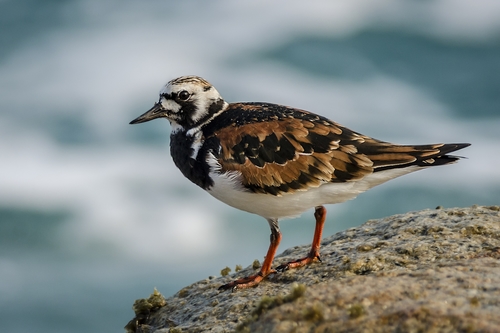
Ruddy Turnstone
Arenaria interpres
The world's most industrious beachcomber, the Ruddy Turnstone is a master of the shoreline that uses its bill like a crowbar to find hidden treasures.
Quick Identification
Size
Length: 21–26 cm (8–10 in); Wingspan: 50–57 cm (20–22 in); Weight: 84–190 g (3–6.7 oz)
Colors
Breeding adults have a striking 'calico' pattern of chestnut-orange, black, and white on their backs. In winter, they transition to a more muted brownish-gray. Both sexes feature bright orange legs and a distinctive black 'necklace' across the chest.
Key Features
- Wedge-shaped, slightly upturned black bill
- Bright orange legs and feet
- Striking harlequin-like facial pattern in breeding plumage
- Bold black and white wing stripes visible during flight
When You’ll See Them
Geographic range
Where Does the Ruddy Turnstone Live?
Native to the high Arctic regions of North America and Eurasia, the Ruddy Turnstone is one of the world's most widely distributed shorebirds. During the breeding season, they occupy the northernmost reaches of Canada, Greenland, and Russia, but they migrate south to inhabit coastlines on nearly every continent. They are commonly found along the Atlantic and Pacific coasts of the United States and Mexico, as well as the shorelines of South America, Africa, Europe, Australia, and various oceanic islands.
Basemap © OpenStreetMap contributors
Behavior
The Ruddy Turnstone is perhaps the most industrious bird on the beach, earned by its namesake habit of using its stout, wedge-shaped bill to flip over stones, shells, and clumps of seaweed in search of hidden prey. They are highly social during the non-breeding season, often found in small, busy flocks that scurry across rocky shorelines with a peculiar, hunched-over gait. Unlike many shorebirds that are easily spooked, turnstones are relatively bold and will often allow humans to observe them from a reasonable distance.
These birds are master navigators and long-distance migrants, traveling thousands of miles between their Arctic breeding grounds and coastal wintering sites. While they are primarily coastal, they are opportunistic and curious, sometimes venturing onto docks, piers, or even coastal parking lots to scavenge for food. Their social structure is loose, but they are known to defend small, temporary feeding territories when food sources like horseshoe crab eggs are abundant.
EverydayEarth exclusive
Camera Tips
To capture the Ruddy Turnstone on a backyard or trail camera, placement is everything. Because these birds are ground-feeders that rarely fly high unless migrating, you must mount your camera just a few inches off the ground. If you live on a coastal property, focus on the 'wrack line'—the high-tide mark where seaweed and debris accumulate. This is their primary grocery store, and they will spend hours Methodically working through the piles.
Since they are active near saltwater, use a protective housing to prevent salt spray from corroding your equipment or blurring the lens. A low-angle 'pancake' style mount on a stable rock or a weighted base in the sand works better than a tripod, which can be unstable in coastal winds. Angle the camera slightly upward to capture the intricate details of their chestnut-and-black plumage against the sky or sea.
While we don't recommend baiting wild shorebirds with human food, you can increase your chances of a sighting by 're-wilding' a patch of your shoreline. Leaving natural driftwood, stones, and washed-up kelp in place will naturally attract the invertebrates that Ruddy Turnstones crave. Set your camera to a fast shutter speed or high-frame-rate video mode; their stone-flipping action is incredibly rapid and can look blurry on standard settings.
The best time for photography is during a rising tide. As the water pushes inward, it forces the birds closer to the upper beach where your camera is likely positioned. Early morning light provides the best color rendition for their bright orange legs and calico feathers, but they are active all day as long as the tide permits foraging.
Similar Species
Species that look similar or are commonly confused with Ruddy Turnstone.
Black Turnstone
Darker overall with blackish legs; lacks the chestnut-orange plumage and is restricted to the Pacific coast of North America.
Sanderling
Smaller and paler with a straight bill; lacks the 'necklace' marking and does not flip stones as aggressively.
Purple Sandpiper
Found in similar rocky habitats but is much darker gray with yellow-based bill and legs, lacking the harlequin facial pattern.
Frequently Asked Questions
Record Ruddy Turnstone at your habitat
Connect a camera to start building your own species record — AI identifies every visitor automatically.