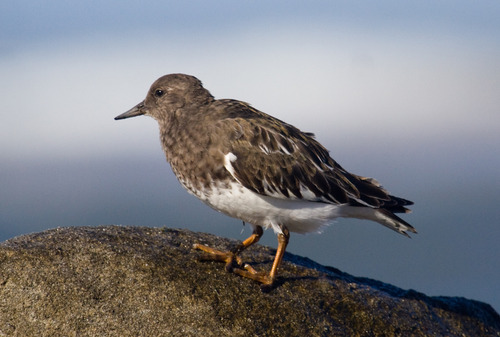
Black Turnstone
Arenaria melanocephala
The master of the Pacific's rocky edge, the Black Turnstone uses its specialized bill to flip stones and hunt where the waves crash. Look for their dramatic black-and-white flight pattern and restless energy along the shoreline.
Quick Identification
Size
Length: 22-25 cm (8.7-9.8 in); Wingspan: 48-55 cm (19-21.7 in); Weight: 100-170 g (3.5-6 oz)
Colors
Sooty-black to dark brownish-gray head, breast, and upperparts; stark white belly and under-tail. In flight, bold white patches on the wings, back, and tail create a high-contrast pattern.
Key Features
- Stout, slightly upturned wedge-shaped black bill
- Dark sooty plumage with a white lower belly
- Striking black-and-white 'harlequin' wing pattern in flight
- Dark blackish-brown legs and stocky build
When You’ll See Them
Geographic range
Where Does the Black Turnstone Live?
Native to the rugged Pacific coast of North America, the Black Turnstone is a regional specialist. These birds breed exclusively on the coastal tundra of western and northern Alaska before migrating south for the winter. Their wintering range extends in a narrow band from the Gulf of Alaska all the way down to the southern tip of the Baja Peninsula in Mexico, making them a common sight for coastal residents along the entire West Coast of the United States and Canada.
Basemap © OpenStreetMap contributors
Behavior
Black Turnstones are the tireless acrobats of the Pacific's rocky intertidal zones. Unlike many sandpipers that delicately probe the mud, these birds use their powerful, wedge-shaped bills as crowbars to flip over stones, shells, and heavy mats of seaweed. They are highly energetic foragers, often seen scurrying just ahead of incoming waves and then rushing back to inspect the freshly washed rocks the moment the water recedes.
In the winter months, they are quite social and frequently congregate in small, noisy flocks alongside other 'rock-loving' shorebirds like Surfbirds and Rock Sandpipers. While they are relatively tolerant of humans, they are incredibly fast; when startled, the entire flock will take flight simultaneously, revealing a dramatic white wing pattern that contrasts sharply with their dark bodies. They are most active during the hours surrounding low tide when their food sources are most accessible.
EverydayEarth exclusive
Camera Tips
Capturing high-quality footage of Black Turnstones requires planning around the tides rather than the sun. To get the best results, set up your camera during a falling tide near a known 'hotspot' like a kelp-covered rocky outcropping or a popular jetty. Because these birds are low to the ground, use a tripod at its lowest setting or a ground-level 'skimmer' pod. A low-angle shot not only makes the bird look more majestic but also helps separate it from the dark, cluttered background of the rocks.
Exposure can be tricky with this species. Their plumage is very dark, which can lead cameras to overexpose the white belly or the surrounding white sea foam. If your camera allows for manual settings, dial in a slightly negative exposure compensation to preserve the detail in the black feathers. Fast shutter speeds (at least 1/1000s) are essential because these birds move their heads and bodies with rapid, jerky motions as they flip stones.
Given the environment, salt spray is your camera's biggest enemy. If you are using a trail camera or an AI-powered backyard camera near the shore, use a protective housing and consider a rain guard. Wipe the lens with a microfiber cloth and fresh water after every session to prevent salt crusting, which will blur your images. Focus your camera on a specific 'action zone,' such as a cluster of mussels or a particularly large rock, and use a motion-trigger setting with a short burst of photos or a 10-second video clip to capture their unique flipping behavior.
Similar Species
Species that look similar or are commonly confused with Black Turnstone.
Ruddy Turnstone
Features bright orange legs and a reddish-brown patterned back compared to the Black Turnstone's uniform dark plumage.
Surfbird
Slightly larger and stockier with yellow legs and a spotted breast rather than a solid black one.
Rock Sandpiper
Has a longer, slightly decurved bill and lacks the bold black-and-white flight pattern of the turnstones.
Frequently Asked Questions
Record Black Turnstone at your habitat
Connect a camera to start building your own species record — AI identifies every visitor automatically.