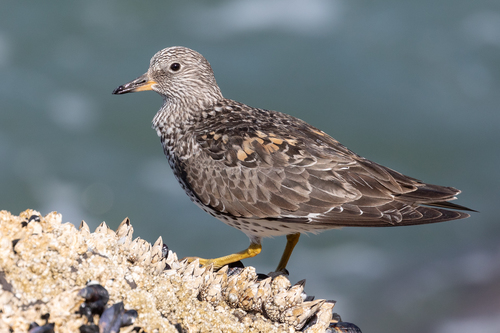
Surfbird
Calidris virgata
A master of the crashing waves, the Surfbird is a hardy wader that swaps the rocky Pacific coastline for high-altitude mountain tundra. Discover how to spot this elusive traveler on its journey from Alaska to the tip of South America.
Quick Identification
Size
Length 24-26 cm (9.5-10.2 in); Wingspan 55-60 cm (21.7-23.6 in); Weight 130-230 g (4.6-8.1 oz)
Colors
Slate-grey upperparts and breast in winter; breeding adults show complex black, white, and rufous mottling. Notable yellow legs and orange-based bill.
Key Features
- Stocky build with short yellow legs
- Strong bill with a dull orange or yellowish base
- Broad white wing stripe and white tail with a black terminal band visible in flight
- Preference for rocky shorelines over sandy beaches
When You’ll See Them
Geographic range
Where Does the Surfbird Live?
Surfbirds are native to the Western Hemisphere, primarily occupying the Pacific corridor. They spend their summers breeding in the rugged mountain ranges of Alaska and the Yukon Territory, far from the sea. During the winter, they undertake a massive migration along the Pacific coast, stretching from the Gulf of Alaska all the way down to the southern tip of Chile and Argentina, making them one of the most widely traveled waders in the Americas.
Basemap © OpenStreetMap contributors
Behavior
The Surfbird is a rugged specialist of the spray-drenched rocky coastline. Unlike many shorebirds that prefer sandy flats or mudflats, Surfbirds are almost exclusively found on tide-washed rocks, often standing unfazed as heavy waves crash around them. They are highly gregarious during the winter months, often seen in tight-knit flocks alongside Black Turnstones and Rock Sandpipers, hopping between barnacle-encrusted boulders to forage.
During the breeding season, their behavior shifts dramatically as they migrate to high-altitude alpine tundra. In these remote mountain settings, they become much more solitary and elusive. They are known for their 'broken-wing' display to distract predators from their well-camouflaged ground nests. Their interaction with humans is generally minimal due to their preference for harsh, inaccessible environments, making them a prized sighting for coastal birdwatchers.
EverydayEarth exclusive
Camera Tips
Capturing Surfbirds on camera requires targeting their specific niche: the rocky intertidal zone. Since they rarely visit inland backyards, your best bet is placing a weather-sealed trail camera on coastal property near jetties or rocky outcroppings. Position the camera at a low angle, roughly 12 to 18 inches off the ground, to capture their stocky profile against the water. Using a wide-angle lens is beneficial here, as it allows you to capture the dramatic crashing waves that define their environment.
Baiting is generally not effective for Surfbirds, as they are specialized foragers of live marine life. Instead, focus on 'bottleneck' locations—specific flat rocks that remain exposed during mid-tide where the birds gather to rest or preen. Because of the high-glare environment of the ocean, set your camera to a slightly lower exposure or use an ND filter if available to prevent the white foam of the waves from blowing out the image. High-speed shutter settings are essential to freeze the action of these fast-moving birds and the spray of the surf.
Timing is everything with this species. Synchronize your camera checks with the local tide tables. The best footage is often captured during a rising or falling tide when the birds are forced to move between feeding spots. During the winter months, these birds are quite active throughout the daylight hours, but the 'golden hour' of late afternoon provides the best lighting to highlight the subtle textures of their plumage and the yellow tones of their legs and bill.
Similar Species
Species that look similar or are commonly confused with Surfbird.
Frequently Asked Questions
Record Surfbird at your habitat
Connect a camera to start building your own species record — AI identifies every visitor automatically.