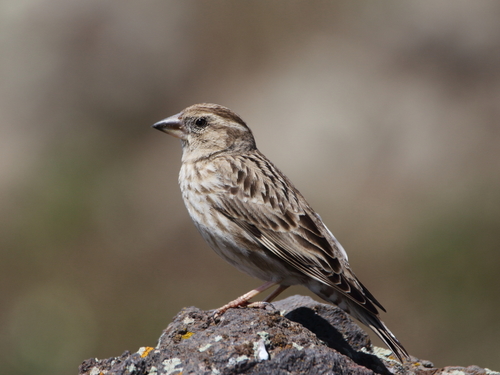
Rock Sparrow
Petronia petronia
Don't let its modest brown plumage fool you; the Rock Sparrow is a hardy specialist of the high cliffs and ancient ruins. With its bold eyebrow and hidden splash of yellow, this resilient bird brings a touch of wild mountain spirit to any backyard lens.
Quick Identification
Size
Length of 15–17 cm (6–6.7 in); wingspan of 28–32 cm (11–12.5 in); weight of 26–39 g (0.9–1.4 oz).
Colors
Dull grayish-brown upperparts with heavy dark streaking; pale underparts with subtle streaks; bold cream-colored eyebrow (supercilium); a diagnostic but often faint lemon-yellow spot on the lower throat.
Key Features
- Broad, pale cream-colored eyebrow stripe
- Distinctive white spots at the tips of the tail feathers
- Small, pale yellow patch on the throat
- Thicker, more conical bill than a typical House Sparrow
When You’ll See Them
Behavior
The Rock Sparrow is a social and somewhat vocal bird, though it tends to be more cautious than its cousin, the House Sparrow. While they are often found in barren, rocky terrains, they are surprisingly adaptable and frequently take up residence in old stone walls, ruins, and even suburban areas with suitable stone architecture. They are highly gregarious outside the breeding season, often forming large mixed flocks with other finches and sparrows to forage for food.
Unlike many other sparrows, the Rock Sparrow has a distinctive upright posture when alert. They spend a significant amount of time on the ground, hopping through rocky crevices or sparse vegetation in search of seeds. During the breeding season, males can be quite territorial, using their "wheezing" song to defend nesting sites in rock cavities or holes in buildings. They are generally tolerant of humans but prefer a bit of distance compared to more urban-dwelling birds.
EverydayEarth exclusive
Camera Tips
To capture the Rock Sparrow on camera, your best bet is to focus on their preferred perching and nesting spots. If you live near rocky outcrops or have old stone walls on your property, place your camera roughly 3 to 5 feet off the ground, angled slightly upward toward a prominent lookout rock or a ledge. These birds love a high vantage point to scan for predators before descending to feed. Using a wide-angle lens or a camera with a decent depth of field is beneficial, as they move quickly between rocky crevices and may trigger the sensor from several different angles.
Attracting them to a specific spot for a photo is easiest with a water feature. Because they live in relatively dry habitats, a shallow stone birdbath or a trickling solar fountain is irresistible to them. Position your camera about 2 to 4 feet away from the water source to get clear, detailed shots of their distinctive markings. For bait, a mix of small cereal grains or sunflower hearts placed on a flat, elevated stone surface works better than a hanging feeder, as they prefer foraging on firm, natural-looking substrates rather than plastic perches.
Since the Rock Sparrow is diurnal, ensure your camera is set to trigger during the golden hours of early morning and late afternoon when the light is soft. Their pale plumage and white tail spots can easily blow out in harsh midday sun, making identification difficult. If your camera has a burst or rapid-fire mode, enable it; these birds are twitchy, and capturing the moment they spread their tail feathers is the only way to clearly see the white terminal spots that distinguish them from other sparrow species.
In winter, when natural food is scarce, Rock Sparrows become less shy and will visit ground feeders more frequently. During this time, consider moving your camera closer to the ground, hidden behind a small bush or rock pile to minimize disturbance. Set your trigger sensitivity to medium-high, as their earthy colors can sometimes blend into the background, making it harder for basic PIR sensors to detect their movement against a similarly colored rocky backdrop.
Similar Species
Species that look similar or are commonly confused with Rock Sparrow.
Frequently Asked Questions
Record Rock Sparrow at your habitat
Connect a camera to start building your own species record — AI identifies every visitor automatically.