Rockpool Prawn
Palaemon elegans
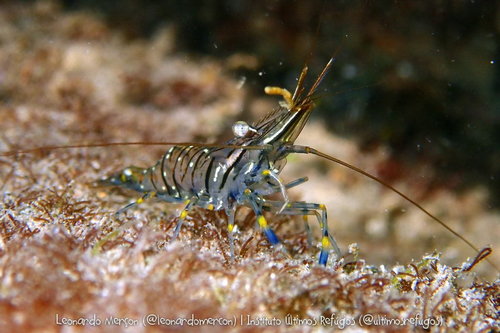
The Rockpool Prawn is the translucent acrobat of the shoreline, instantly recognizable by its striking zebra-like stripes and neon-jointed legs. A constant blur of motion, these hardy crustaceans are the star attraction of every tide pool.
Quick Identification
Size
Typically 3–6 cm (1.2–2.4 inches) in length
Colors
Translucent body with prominent horizontal dark brown or black stripes; legs and pincers feature striking yellow and blue bands at the joints
Key Features
- Translucent body with bold horizontal dark stripes
- Vibrant yellow and blue bands on the walking legs and pincers
- Serrated rostrum (horn) extending forward from the head
- Two pairs of long, sensitive antennae
When You’ll See Them
Behavior
The Rockpool Prawn is an energetic and inquisitive inhabitant of the intertidal zone. Unlike many marine creatures that hide at the first sign of movement, these prawns are remarkably bold, often seen busily darting across the floor of a tide pool or hovering mid-water. They are highly social and are frequently found in large numbers where food sources are plentiful, using their delicate pincers to pick through algae and sediment.
These prawns are masters of the 'tail-flip' escape maneuver. When they sense a predator—such as a crab or a shore bird—they rapidly flex their muscular abdomen to propel themselves backward with surprising speed. To humans, they are often the most charismatic residents of the shoreline; if you keep your hand still in a pool, they may even approach to 'clean' your skin with their tiny claws.
EverydayEarth exclusive
Camera Tips
To capture the Rockpool Prawn on camera, you will need a waterproof setup, such as an action camera (like a GoPro) or a specialized underwater trail camera. Success depends entirely on the tide; you want to place your camera in a rock pool that remains submerged even at low tide. Secure the camera to a heavy base or wedge it firmly between rocks at the bottom of the pool, angling the lens toward a flat, sandy patch or an area with interesting seaweed growth.
The secret to great footage of this species is 'scent-based' baiting. Place a small mesh bag containing crushed shellfish, a piece of oily fish, or even cat food just inside the camera's field of view. Within minutes, the prawns will emerge from the crevices to investigate, providing excellent opportunities for close-up shots of their feeding behavior and intricate leg movements. Because they move very quickly, use a high frame rate setting (at least 60fps) to ensure the video remains sharp when they dart away.
Lighting is often the biggest hurdle underwater. Try to film on a bright day but avoid mid-day sun if the water is very shallow, as the reflection can cause harsh highlights. An overcast day often provides the best diffused light for revealing their translucent bodies. If your camera has a macro mode or a close-focusing lens, enable it, as these prawns are small and the most fascinating details are in their banded legs and flickering antennae.
Similar Species
Species that look similar or are commonly confused with Rockpool Prawn.
Frequently Asked Questions
Record Rockpool Prawn at your habitat
Connect a camera to start building your own species record — AI identifies every visitor automatically.